Rhodes Travel Guide: History, Beaches & Everything You Need to Know
Rhodes is one of those rare places that genuinely has it all. On the eastern edge of the Aegean, where the sea turns a little deeper blue and the sun burns a little longer, this island packs medieval history, world-class beaches, vibrant nightlife, and some of the freshest seafood in Greece into one destination. It is the fourth-largest Greek island — and arguably the most varied.
The walled Old Town of Rhodes is a UNESCO World Heritage Site, and walking its cobbled streets at dusk, past the Palace of the Grand Master lit in amber, feels like stepping into another century entirely. But Rhodes is never just a history lesson. Drive twenty minutes south and you are on a windswept beach with almost no one around. Drive north and you hit a beach club full of Europeans in their element. The island accommodates both kinds of traveller without apology.
Whether you are planning a romantic escape, a family holiday, or a solo adventure, this guide covers everything you need to know to make the most of Rhodes — from the best beaches and where to stay, to the hidden villages and the ideal time to visit.
Note: This page contains affiliate links. We may earn a small commission at no extra cost to you when you book through our links. This helps us keep creating free travel guides.
Rhodes at a Glance
Rhodes sits at the southeastern tip of the Aegean Sea, closer to Turkey (just 18 km away) than to Athens. The island is about 78 km long and home to roughly 115,000 people year-round — a number that more than doubles in summer. Rhodes Town, in the north, is the capital and main hub; the rest of the island fans out in a mix of resort towns, quiet villages, and pine-forested hillsides.
The island is part of the Dodecanese island group and has a history shaped by Greeks, Romans, Byzantines, the Knights of Saint John, Ottoman Turks, Italians, and finally modern Greece. That layered past is visible everywhere — in the architecture, the cuisine, and the landscape.
When to Visit Rhodes
The honest answer: May, June, and September are the sweet spots. The weather is warm and settled, the sea is swimmable, and the island is busy but not overwhelmed. July and August are peak season — and Rhodes in August feels fully packed. Hotels book out months in advance, prices spike, and the Old Town can feel more like a cruise ship stopover than a medieval city.
If you want a calmer, more local experience, late April and early October are also worth considering. The sea takes a little longer to warm up in spring and cools down faster in autumn, but the island is beautiful in a quieter way.
Quick Season Summary
- April – May: Warm, quiet, green hillsides. Best for sightseeing and hiking.
- June: Perfect beach weather without the full summer rush.
- July – August: Hot, busy, buzzing. Book everything early.
- September: Still warm, crowds thinning, great value.
- October – March: Low season. Many hotels close. Better for short trips or exploring inland.
How to Get to Rhodes
Rhodes International Airport (Diagoras, RHO) is one of the busiest in Greece during summer. Direct flights connect the island to most major European cities — London, Amsterdam, Berlin, Vienna, Warsaw, Stockholm — as well as Athens and Thessaloniki year-round.
From Athens, the flight takes about 55 minutes. From Northern Europe, direct charter and scheduled flights typically run from May through October. Budget airlines including Ryanair and easyJet serve Rhodes from several European hubs.
You can also reach Rhodes by ferry from Athens (Piraeus), which takes around 12–18 hours depending on the route and vessel. Ferries also connect Rhodes to other Dodecanese islands including Kos, Symi, Tilos, and Patmos — useful for island hopping.
Getting Around the Island
Rhodes is a large island and public transport, while functional in the north, is limited elsewhere. To see more than just Rhodes Town and Faliraki, renting a car is genuinely worth it. The road network is good, distances are manageable, and having your own wheels opens up the southern half of the island — which most visitors never reach.
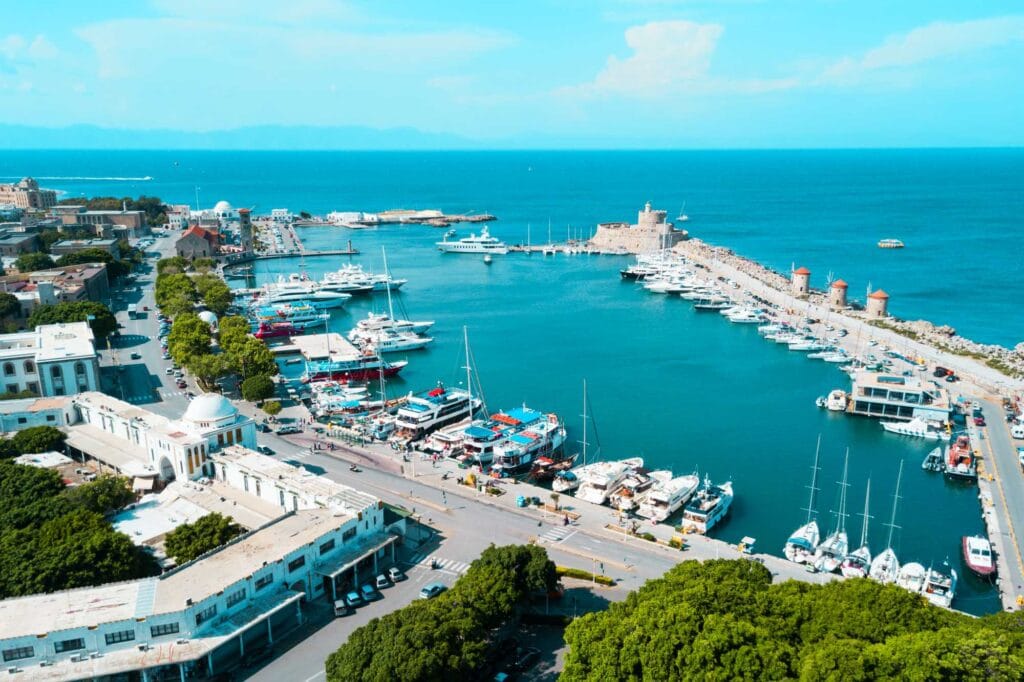
Scooters and motorbikes are popular for shorter trips and coastal routes. For the town itself, most attractions in Rhodes Old Town and Mandraki Harbour are walkable once you are there.
Getting Around: Quick Options
- Rental car: Best option for exploring the whole island. Book in advance for peak season.
- Local buses (KTEL): Connect Rhodes Town to main resorts and some villages. Cheap but infrequent.
- Taxis: Available in Rhodes Town. Use a metered taxi or agree on price for longer trips.
- Scooter/quad: Fun for short distances. Not ideal on mountain roads.
Rhodes Old Town: A UNESCO Walking Tour
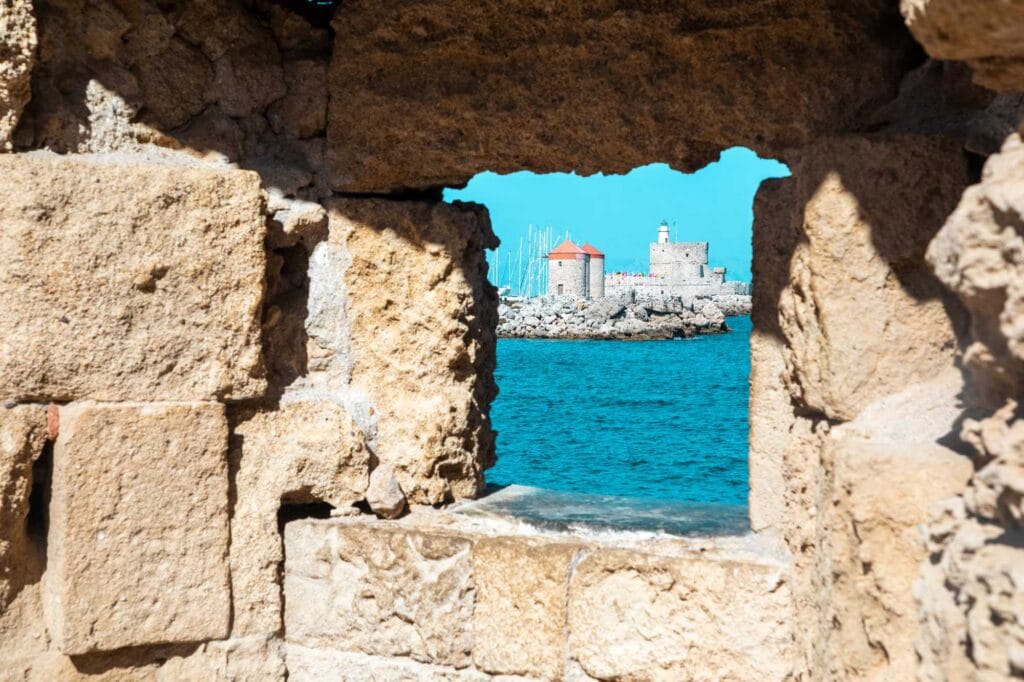
The Old Town of Rhodes is one of the best-preserved medieval walled cities in Europe. Built by the Knights Hospitaller in the 14th and 15th centuries, the fortifications still stand intact — a double ring of moats, ramparts, and towers enclosing a labyrinth of narrow streets, Byzantine churches, Ottoman mosques, and grand Gothic architecture.
Allow at least half a day here, ideally a full day. It is easy to get pleasantly lost. The streets are not signed consistently, but that is part of the experience. Every turn reveals a fountain, a crumbling archway, or a courtyard restaurant that seems to have been there for centuries.
Key Sights Inside the Old Town
- Palace of the Grand Master: The crown jewel of the Old Town. A restored 14th-century fortress with mosaic floors and grand halls. One of the most impressive medieval buildings in the Mediterranean.
- Street of the Knights (Ippoton): The most iconic street in Rhodes — a perfectly preserved medieval lane flanked by the stone inns of the different knightly orders.
- Archaeological Museum of Rhodes: Set inside the Gothic Hospital of the Knights. Home to a fine collection of classical sculpture, including the famous marble Aphrodite of Rhodes.
- Suleiman Mosque: Built after the Ottoman conquest in 1522. The pink exterior is striking against the medieval stonework around it.
- Jewish Quarter (La Juderia): The atmospheric southeastern corner of the Old Town. The Kahal Shalom Synagogue, dating from 1577, is among the oldest still functioning in Europe.
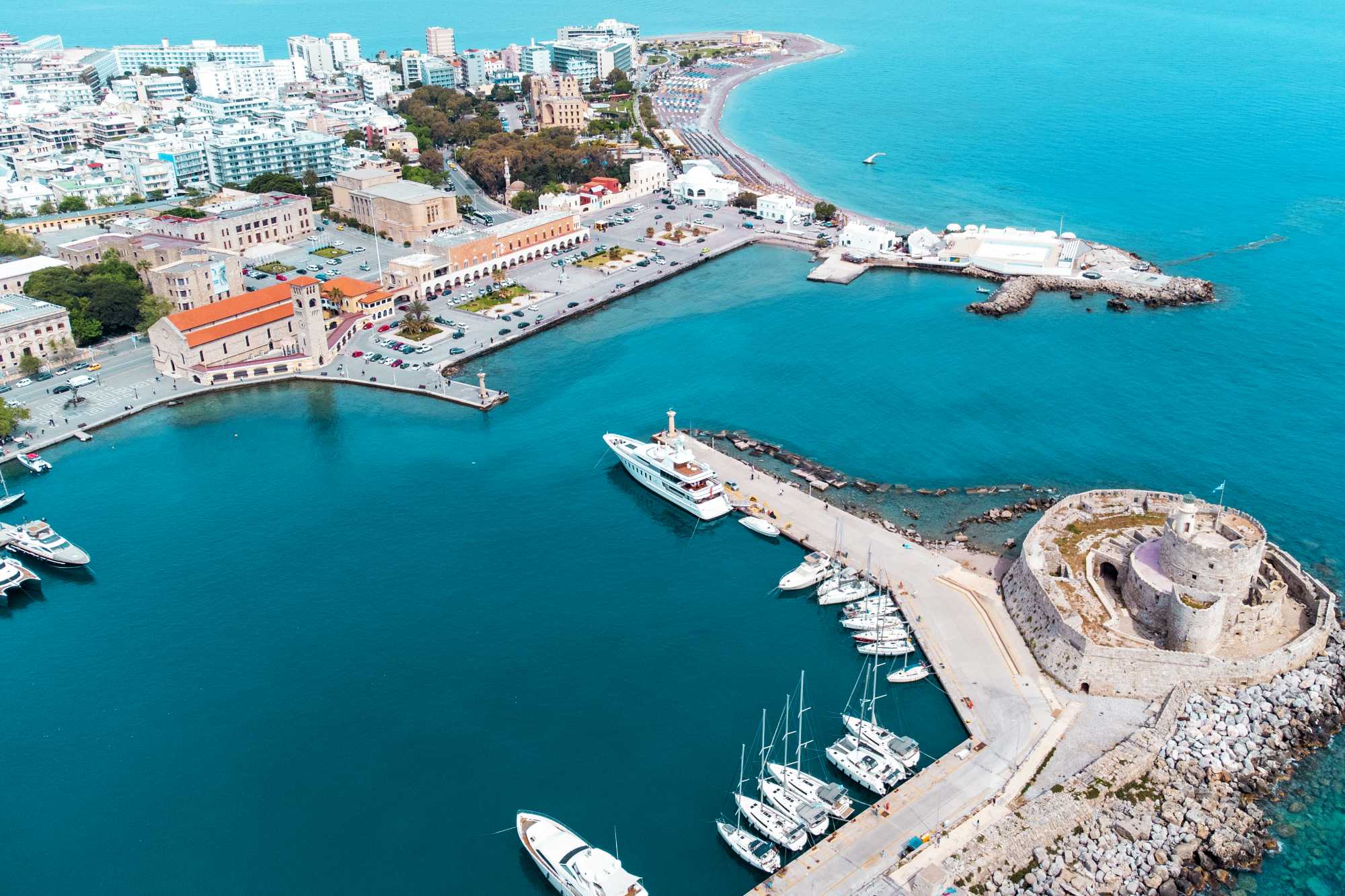
- Mandraki Harbour: Just outside the Old Town walls. The spot where the Colossus of Rhodes allegedly once stood, marked today by two bronze deer on pillars.
A practical tip: the Old Town is far more enjoyable in the early morning or early evening, when the day-trip crowds have gone. If you are staying elsewhere on the island, plan at least one evening dinner inside the walls.
Best Beaches in Rhodes
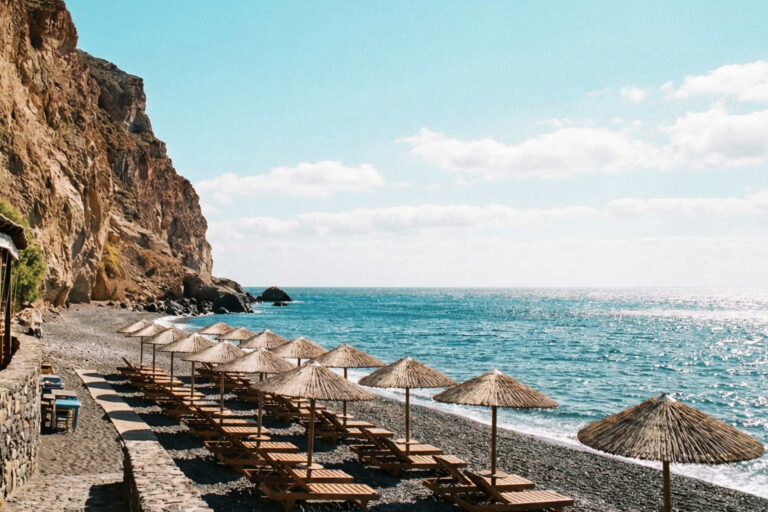
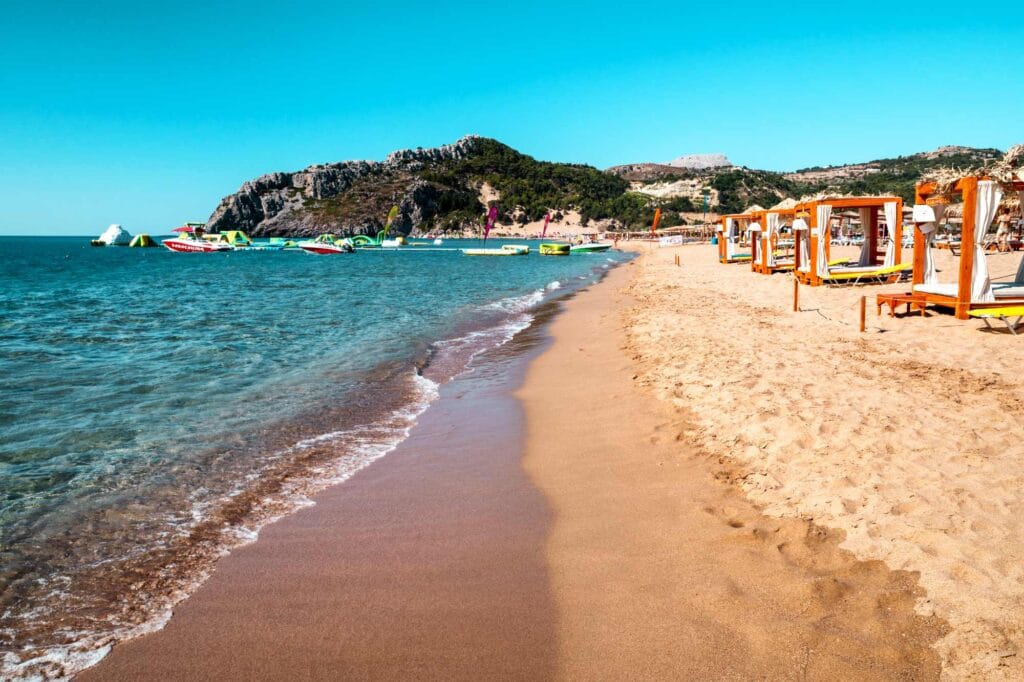
Rhodes has beaches for every preference — from organized resort strips with sun loungers and cocktails, to quiet coves where you share the water with a handful of locals. The west coast tends to be windier (popular with windsurfers), while the east coast offers calmer, clearer water better suited for swimming.
East Coast (Calmer Water)
- Tsambika Beach: One of the island’s most photographed beaches. A long arc of golden sand backed by a monastery on a clifftop. Organized, but large enough not to feel crowded.
- Lindos Beach & St. Paul’s Bay: Two beaches flanking the famous village of Lindos. St. Paul’s Bay is particularly lovely — sheltered, turquoise, and intimate.
- Agathi Beach: Smaller and quieter than Tsambika, with excellent water clarity. Worth the extra effort to reach.
- Vlycha Beach: Just outside Lindos. Calm, long, and well-organized. Popular with families.
West Coast (Windy, Dramatic)
- Prasonisi Beach: At the southern tip of the island where the Aegean meets the Mediterranean. The wind split creates a wave side and a flat side — a paradise for kitesurfers and windsurfers.
- Ixia Beach: Close to Rhodes Town. Famous for water sports. Not the most scenic but buzzing with energy.
Near Rhodes Town
- Elli Beach: The main town beach. Pebble and sand, with clear water, a diving platform, and a promenade feel.
- Anthony Quinn Bay: Named after the actor who filmed Guns of Navarone here. A scenic rocky cove with incredibly clear water — one of the most photographed spots on the island.
Top Things to Do in Rhodes
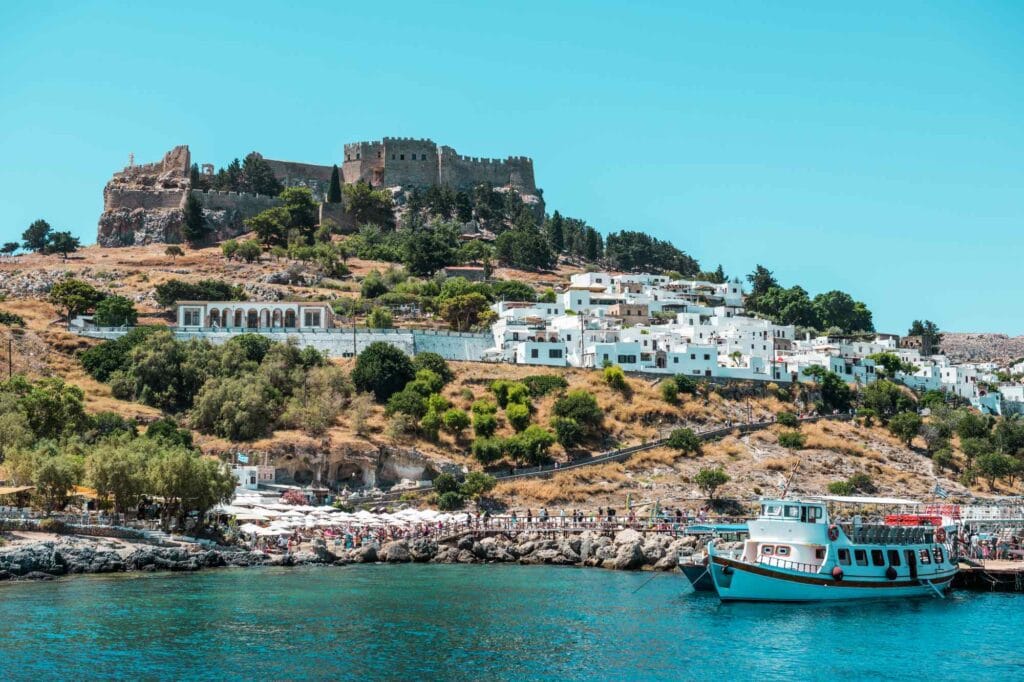
- Explore Lindos: The hilltop village of Lindos is the island’s most iconic non-Town destination. The ancient Acropolis of Lindos sits on a clifftop above a whitewashed village of captains’ houses with pebbled courtyards. The views down to St. Paul’s Bay are extraordinary.
- Visit the Valley of the Butterflies (Petaloudes): In July and August, thousands of Jersey Tiger moths (often called butterflies) mass in a cool, shaded valley. A surreal and beautiful experience.
- Take a day trip to Symi: The island of Symi is just over an hour from Rhodes by ferry. Its neoclassical coloured houses and harbour are genuinely stunning — one of the most beautiful spots in the Aegean.
- Climb to Filerimos: A hilltop monastery and ancient ruins above the village of Ialyssos, with sweeping views toward Turkey. The avenue of cypress trees leading up is particularly atmospheric.
- Watch the sunset from Zia: The mountain village of Zia in the centre of the island has become something of a sunset pilgrimage site. Touristy, but the views are worth it.
- Wander Archangelos: One of the island’s largest and most traditional villages. Less visited than Lindos, with a ruined castle and authentic tavernas.
Best Villages to Visit in Rhodes
The resorts along the coast get the most attention, but Rhodes has a rich interior that most package tourists never see. Renting a car and driving through the villages is one of the most rewarding ways to spend a day on the island.
- Lindos: Already covered above — essential.
- Embonas (Embona): A wine-producing village in the foothills of Mount Attavyros. Stop at a local winery and try Athiri and Mandilaria, the island’s main grape varieties.
- Laerma: A sleepy village surrounded by forest, close to the Thari Monastery — one of the oldest on the island and still inhabited by monks.
- Monolithos: A dramatic clifftop castle ruins near a small village on the west coast. Worth the drive for the views alone.
- Kritinia: Another hilltop Venetian castle, less visited than Monolithos, with wonderful coastal panoramas.
Where to Stay in Rhodes
Rhodes has accommodation for every style and budget, from luxury clifftop villas overlooking the sea to family-friendly resort hotels in Faliraki. The key question is where you want to base yourself.
Rhodes Town & Old Town
Staying inside or near the Old Town puts you at the heart of history and makes evening exploration easy. Hotels here tend to be boutique — charming, often atmospheric, sometimes in converted medieval buildings. This is the best base for couples and solo travellers.
Ixia & Ialyssos (North West)
Just minutes from Rhodes Town, this stretch offers larger resort hotels with beach access and good facilities. Popular with families and package tourists.
Lindos Area (East Coast)
Staying near Lindos means being close to the best beaches and the iconic village. The trade-off is distance from Rhodes Town — about 50 km south. Worth it if you have a car and plan to explore the south of the island.
Faliraki (East Coast, Closer to Town)
Rhodes’ main party resort. Good for younger travellers who want nightlife and organized beach facilities close together. About 16 km from Rhodes Town.

What to Eat (and Where)
Rhodian food is a slightly different take on Greek cuisine — influenced by centuries of diverse rule, and notably by the proximity to Turkey and the Levant. Dishes are generous, flavours are bold, and fresh fish appears on almost every menu.
What to Order
- Pitaroudia: A local speciality — fried chickpea fritters seasoned with cumin and herbs. Completely addictive.
- Melekouni: A traditional Rhodian sweet made from sesame and honey. Found at bakeries and local shops.
- Fresh fish at the harbour: Particularly good in Mandraki and in the Old Town’s back streets. Ask what came in that morning.
- Rhodian wine: The island has a small but serious wine scene. Try a glass of local white Athiri with your meal.
- Souvlaki and gyros: Universal throughout Greece, but particularly satisfying after a long day of walking.
Where to Eat
- Inside the Old Town: Several excellent restaurants tucked into the medieval lanes — look for places with handwritten menus and a few locals.
- Archangelos and inland villages: The least touristy food on the island. Family tavernas serving slow-cooked lamb and fresh greens.
- Lindos: Beautiful setting, higher prices. Save a dinner here for the view.
Rhodes with a Rental Car: Day Trip Ideas
If you have a car, a full loop of the island takes one long, rewarding day. Here is a rough route to consider:
- Morning: Leave Rhodes Town early. Drive south on the east coast, stopping at Tsambika Beach and Agathi.
- Late morning: Lindos — walk up to the Acropolis before the heat peaks. Have lunch in the village.
- Afternoon: Continue south through Lardos and Gennadi toward Prasonisi. The landscape gets wilder and emptier the further south you go.
- Late afternoon: Head north up the west coast through Monolithos, Embonas, and Filerimos. Stop for sunset at Zia.
- Evening: Arrive back in Rhodes Town for dinner inside the Old Town walls.
This is an ambitious loop — around 200 km — but completely doable. It shows you the island’s range in a single day.
Explore More About Rhodes
- Best Hotels in Rhodes: Where to Stay
- Rhodes Town: History, Culture & What to See
- Greek Islands: How to Choose the Best Island for Your Trip
- Island Hopping in Greece: The Ultimate Guide
- Getting Around Greece: Ferries, Flights & Cars
- Plan Your Trip: All Resources in One Place
FAQ: Rhodes Travel Guide
Is Rhodes worth visiting?
Absolutely. Rhodes offers a rare combination of genuine medieval history, excellent beaches, traditional villages, and reliable sunshine. It works well for couples, families, solo travellers, and history enthusiasts alike. The Old Town alone justifies the trip.
How many days do you need in Rhodes?
Five to seven days is the ideal window. Three days gives you the Old Town, Lindos, and a beach or two. A full week lets you drive the island, reach the quieter south, and explore inland villages without rushing.
What is Rhodes best known for?
The medieval Old Town, which is a UNESCO World Heritage Site, and the ancient Colossus of Rhodes — one of the Seven Wonders of the Ancient World (no longer standing). Today, Rhodes is also known for its beaches, particularly around Lindos, and its lively tourist infrastructure.
Is Rhodes good for families?
Yes. The island has calm, sheltered beaches on the east coast that work well for children, a wide range of family-friendly hotels and resort facilities, and enough activities — including the Valley of the Butterflies and Lindos — to keep everyone engaged.
When should I avoid Rhodes?
August is peak season with higher prices, full hotels, and the busiest beaches. If you dislike crowds and heat, this is the month to avoid. Rhodes can also be quite hot in July. For a more relaxed visit, May–June or September are significantly better.
Do I need a car in Rhodes?
Not if you plan to stay in Rhodes Town and visit only nearby beaches. But if you want to explore Lindos, the east coast beaches, the inland villages, or the southern tip of the island at Prasonisi, a car makes a significant difference. Rhodes is a large island and public transport is limited outside the main resorts.
Is Rhodes expensive?
Rhodes sits in the mid-range for Greek island costs. It is more affordable than Santorini or Mykonos, but high season prices in Lindos and the Old Town can still be substantial. Eating in local tavernas rather than tourist restaurants, and booking accommodation well in advance, keeps costs manageable.
Can I do a day trip to Symi from Rhodes?
Yes — Symi is one of the most popular and rewarding day trips from Rhodes. High-speed ferry and excursion boats run daily in summer, with a crossing of around one hour. Symi’s neoclassical architecture and harbour are among the most beautiful in the Aegean.
Ready to Plan Your Rhodes Trip?
Rhodes rewards travellers who go beyond the beach. Whether you spend your time walking the ancient streets of the Old Town, chasing empty coves on the east coast, or sitting with a glass of local wine in a hilltop village watching the sun drop into the sea — this island delivers.
Start by sorting your key logistics below, and we will help you put together a trip worth remembering.