Rhodes Town: History, Culture & What to See
There are medieval cities across Europe, and then there’s Rhodes Town. Walking through the Gate of St. John into the Old Town, you’re stepping inside the most completely preserved medieval city in the entire Mediterranean — a place where the Knights of St. John built their fortress capital in the 14th century and time, remarkably, never quite caught up.
Rhodes Town sits at the northern tip of Rhodes island, and it’s unlike anywhere else in Greece. While most Greek destinations celebrate whitewashed walls and clifftop sunsets, this city gives you cobblestoned streets wide enough for horses, a palace that rival kings coveted, and a harbor where ancient warships once anchored. The legend of the Colossus of Rhodes — one of the Seven Wonders of the Ancient World — was born here.
This guide covers everything you need to know about Rhodes Town: the key sights, the best neighborhoods to explore, where to eat, when to go, and how to use the city as your base for discovering the rest of the island.
Why Rhodes Town Deserves More Than a Day
Rhodes is one of Greece’s most visited islands — and most visitors base themselves in beach resorts along the east coast. That’s understandable. But it means the capital is often treated as a half-day excursion: arrive by bus, take a few photos of the Palace, wander through the market street, leave.
That’s enough to get an impression. It’s not enough to actually understand what you’re looking at. Rhodes Town rewards slowness. The Old Town has layers that reveal themselves only when you’re willing to get lost in the back streets, skip the souvenir shops on Socratous Street, and find the quiet squares where locals drink coffee beside 600-year-old walls.
Plan for at least two full days. You’ll use every hour of them.
The Old Town: A UNESCO World Heritage Site
The Old Town of Rhodes is the largest inhabited medieval town in Europe and a UNESCO World Heritage Site since 1988. It covers roughly 45 hectares, enclosed within 4 km of Venetian-era walls built by the Knights Hospitaller — the military order that ruled Rhodes from 1309 to 1522.
Everything inside those walls has been continuously inhabited since the medieval period. The streets follow their original medieval layout. Many of the buildings — churches, inns, administrative buildings — still stand in recognizable form. Walking through the old town is not a reconstruction or a museum; it’s a functioning city that happens to be 700 years old.
The Three Districts of the Old Town
The Old Town is traditionally divided into three areas:
- The Collachium (Knights’ Quarter) — the northern section, home to the Street of the Knights and the Palace. This is the most intact medieval district and the most architecturally impressive.
- The Chora (Burgo) — the larger southern section, historically the civilian and commercial quarter. More lived-in, more atmospheric, and far less visited than the northern end.
- The Jewish Quarter (Evraiki) — the southeastern corner, centered around Plateia Evraion Martyron (Square of the Jewish Martyrs). A quiet, poignant area with a small synagogue still in use.
Top Things to Do in Rhodes Town
Palace of the Grand Masters
The Palace of the Grand Masters is the visual centerpiece of Rhodes Town — a 14th-century fortress palace that was the administrative and spiritual headquarters of the Knights of St. John. It was heavily damaged in an 1856 gunpowder explosion and later restored (controversially) by the Italian administration in the early 20th century.
The interior houses two permanent exhibitions: one on ancient and medieval Rhodes, another on the Italian occupation period. The floors throughout the palace are covered with extraordinary Byzantine and early Christian mosaics brought from the island of Kos — worth the entry price alone.
The palace is open daily except Mondays. Arrive early; it fills up quickly on summer mornings.
The Street of the Knights (Ippoton)
Running from the Palace down to the Hospital of the Knights, the Street of the Knights is one of the best-preserved medieval streets in the world. The Inns of the various ‘tongues’ (nationalities) of the Knights line both sides — France, Italy, Spain, England, Germany, Provence, Auvergne — each with their distinctive heraldic stonework above the doorways.
It’s a short street (about 200 meters) but incredibly dense with detail. Walk it in the early morning when the light is right and the tour groups haven’t yet arrived.
The Archaeological Museum of Rhodes
Housed in the beautifully restored Hospital of the Knights — itself a remarkable 15th-century building — the Archaeological Museum holds an impressive collection spanning the island’s history from prehistoric times through the Hellenistic period. The highlight for many visitors is the small marble statue of Aphrodite bathing, one of the finest Hellenistic sculptures in Greece.
The Medieval Walls & Moat Walk
The fortifications of the Old Town are extraordinary in their scale and state of preservation. A guided walk along the walls offers views over both the old and new town, and gives a real sense of the defensive engineering the Knights invested in. The moat below the walls (which was never filled with water — it was a dry defensive ditch) is now a pleasant park-like area, and parts of it are walkable.
Plateia Evraion Martyron (Square of the Jewish Martyrs)
This quiet square in the southeastern corner of the Old Town honors the 1,700 Jewish residents of Rhodes who were deported to Auschwitz in 1944. The Kahal Shalom Synagogue — built in 1577 and one of the oldest in Europe — is nearby and open to visitors. This is one of the most moving and least-visited corners of the Old Town.
Socratous Street — The Main Market Street
Socratous Street is the Old Town’s main commercial artery, running from the harbor toward the Turkish Quarter. It’s busy, loud, and full of souvenir shops — but also home to some genuinely good jewellery and ceramics shops if you look past the tourist trinkets. The Mosque of Suleiman at the top end is a reminder of the Ottoman period (1522–1912) that followed the Knights.
The Turkish Quarter (around the mosque) has a distinct character — hammam, covered market, and narrow streets that feel different from the Knights’ district.
The New Town & Mandraki Harbor
Outside the Old Town walls, the New Town (Neochori) stretches north and west. It’s a functioning modern city with shops, restaurants, and the main commercial harbor at Mandraki.
Mandraki Harbor
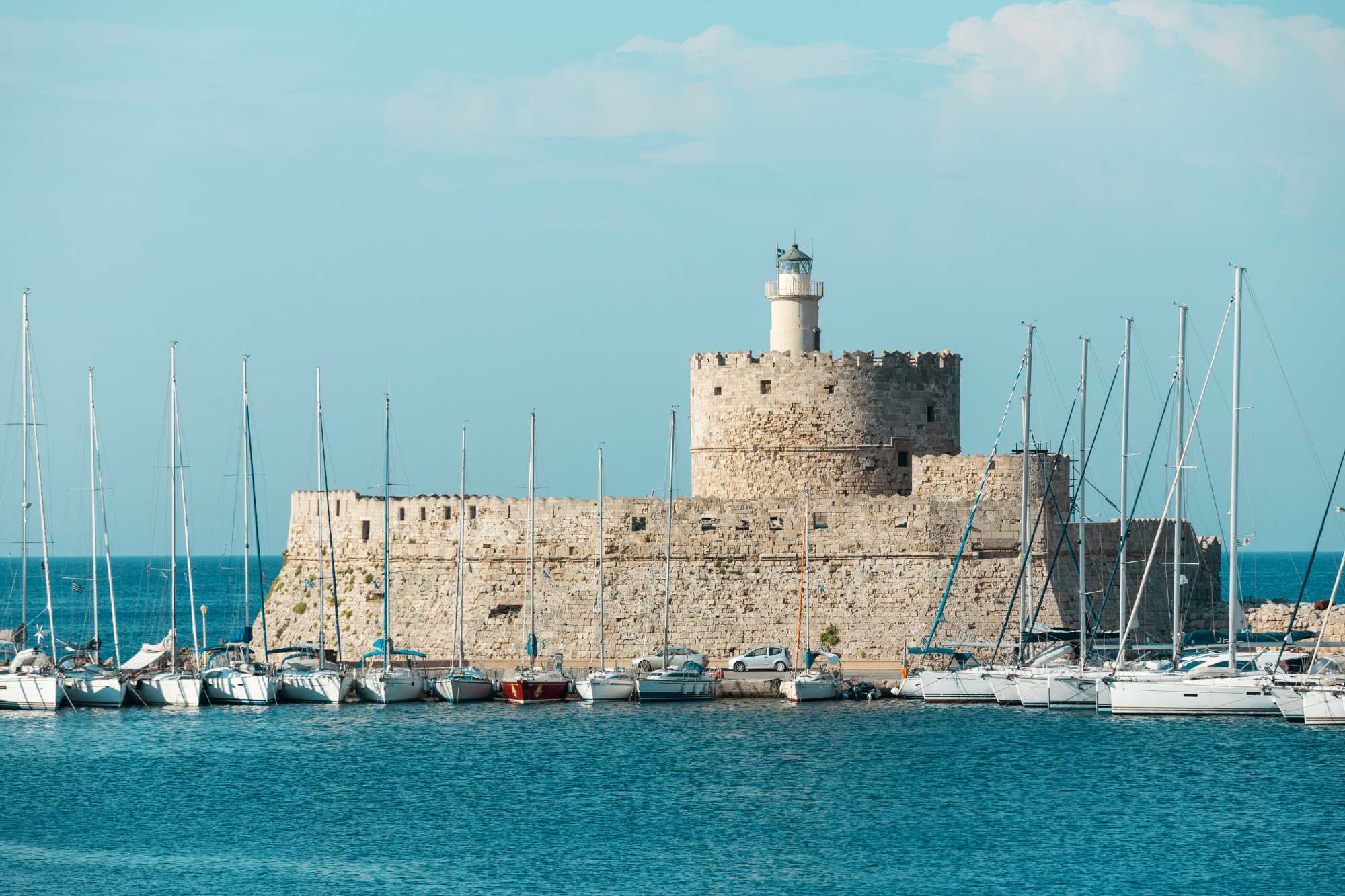
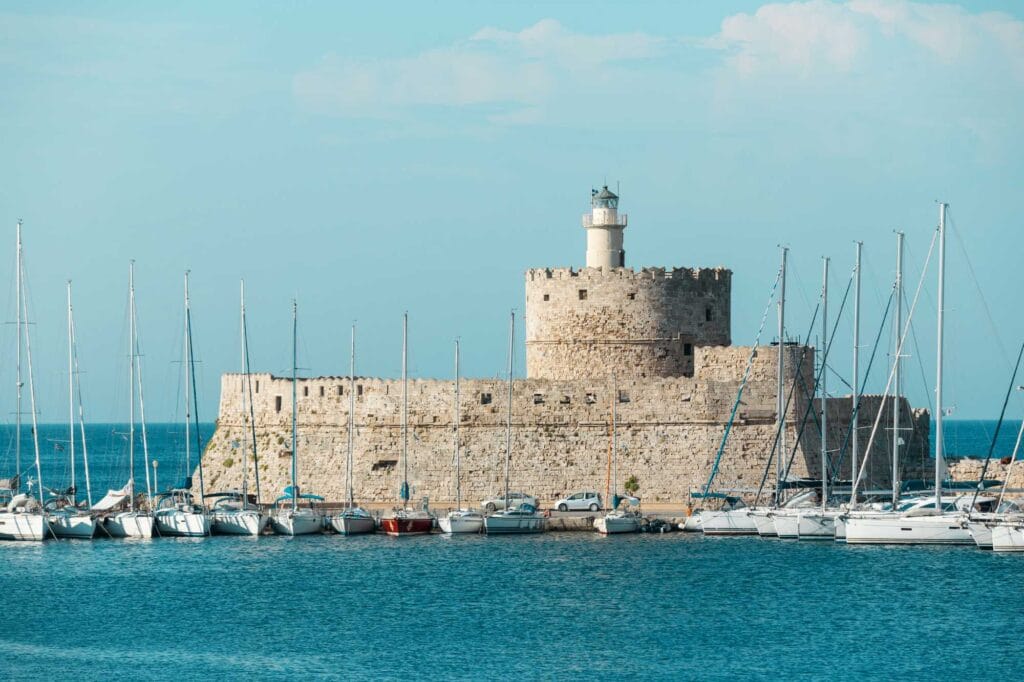
Mandraki is the old commercial and ceremonial harbor, lined with windmills and protected by the Fort of St. Nicholas at the entrance. The famous Colossus of Rhodes — a bronze statue of the sun god Helios that was one of the Seven Wonders of the Ancient World — is said to have stood near this harbor, though its exact location remains unknown. Two bronze deer (a stag and a doe) now mark the harbor entrance where the Colossus may once have stood.
The harbor is a pleasant evening walk, lined with excursion boats, yachts, and the occasional pelican that has decided it lives here.
The Aquarium & Hydrobiological Institute
At the northernmost tip of the island, the Rhodes Aquarium occupies a beautiful art deco building from the Italian period. It’s small but well done, with a good display of Aegean marine life — a good option with families or on a hot afternoon when outdoor sightseeing loses its appeal.
Beaches Near Rhodes Town
Rhodes Town itself has accessible urban beaches on both its eastern and western sides, though the best swimming is found a short drive from the center.
Elli Beach (New Town)
The main city beach, right at the north end of the New Town. Sandy, organized, and easily walkable from the Old Town. It gets crowded in peak season, but the water is clear and it’s convenient. The famous Art Deco lido building at Elli has been partially restored and adds character to the seafront.
Akti Miaouli (East Side)
The pebble beach on the eastern side of the Old Town — less crowded than Elli, and backed by the medieval walls. The dramatic setting makes it worth visiting even just to sit on the stones and look back at the fortifications.
Faliraki & East Coast Beaches — 15 km South
For proper beach days, the east coast resorts south of Rhodes Town — Faliraki, Afantou, Kolymbia — offer long sandy stretches with calmer water. The drive down the coast is pleasant and easy.
For a complete overview of Rhodes beaches and the island beyond the capital, see our Rhodes Travel Guide. [LINK: /islands/rhodes/]
Where to Eat & Drink in Rhodes Town
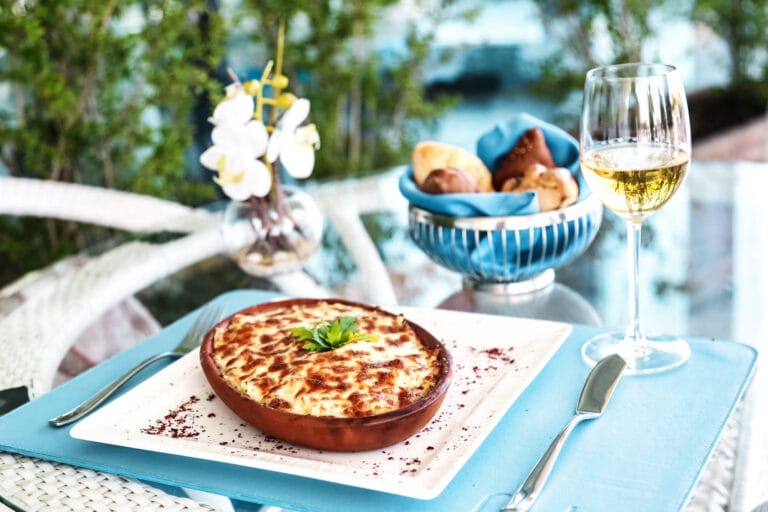
The Old Town has a concentration of tavernas and restaurants, with quality ranging from tourist-trap mediocre to genuinely excellent. The key is to push past Socratous Street and into the side streets of the Chora, where restaurants serve local Rhodian food rather than an international approximation of Greek cuisine.
What to Look For
- Pitaroudia — chickpea fritters with mint, a local Rhodian specialty you won’t find easily elsewhere
- Fresh grilled fish — ask what came in that day and order that, rather than anything pre-frozen
- Melekouni — a traditional sesame and honey bar, made in Rhodes for centuries, sold at bakeries and sweet shops
- Local wine — Rhodes has its own wine tradition; CAIR and Emery are the main producers, with some good dry whites
- Soumada — a non-alcoholic almond syrup drink, traditional at local celebrations, unusual and worth trying
Where to Eat
The squares inside the Old Town — particularly around the Turkish Quarter and the quieter streets south of Socratous — have the best tavernas. Look for places with handwritten menus in Greek (with English translation), plastic chairs, and no one standing at the door beckoning you in. Those are the ones that don’t need to hustle.
For evening drinks, the streets around Plateia Arionos (the square with the old mosque) in the Chora fill up with young locals from around 9pm onward — a very different atmosphere from the harbor-area bars.
Day Trips from Rhodes Town
Rhodes island is large enough to warrant several days of exploration beyond the capital. A rental car makes the difference between seeing three things and seeing everything.
Lindos — 55 km South
The most visited day trip from Rhodes Town, and for good reason. Lindos is a whitewashed village built around an ancient acropolis perched on a dramatic 116-meter cliff above a turquoise bay. The Acropolis of Lindos (with its Temple of Athena and Hellenistic stoa) is one of the most atmospheric archaeological sites in Greece. Arrive early — Lindos is genuinely crowded by mid-morning in summer.
Valley of the Butterflies (Petaloudes) — 25 km West
One of the more unusual natural attractions in Greece: a forested valley where thousands of Jersey tiger moths gather during summer, covering the trees in waves of russet and white. It’s an extraordinary sight if you’re there at the right time (July–August peak). The valley is also simply a beautiful shaded walk.
Ancient Kamiros — 36 km Southwest
One of three ancient cities of Rhodes, Kamiros is the least visited and arguably the most rewarding. Unlike Lindos, there are no souvenir shops and rarely any crowds. The ruins of this Doric city — residential streets, water cisterns, a Hellenistic stoa — are well-preserved and the views over the western coast are beautiful.
Mount Attavyros & Embonas Village
The highest point on Rhodes island (1,215 m) sits above the wine-producing village of Embonas, where local wineries offer tastings. The drive through the interior of the island reveals a completely different landscape from the coastal resorts — pine forests, terraced hillsides, and traditional villages.
How to Get Around Rhodes Town
On Foot
The Old Town is completely pedestrianized and best explored on foot. Everything within the walls is within a 15-minute walk. The New Town and harbor are a 10-minute walk from the Old Town gates.
Local Buses (KTEL)
Rhodes Town has two bus stations: one serving the east coast (near Mandraki harbor, connects to Faliraki, Lindos, and east coast resorts) and one serving the west coast (near the New Market). Buses are affordable and reliable for getting to the main destinations.
Car Rental
Essential for reaching Lindos, Ancient Kamiros, and any of the interior villages. Book in advance for summer — Rhodes is a popular island and rental availability can tighten. Pick up from the airport or from the many agencies along the harbor road in the New Town.
Taxis
The main taxi rank is at Mandraki harbor. Metered, reliable, and reasonably priced for short trips. For longer day trips, agree on a fixed price in advance — drivers are generally open to negotiating a round-trip rate for Lindos and similar destinations.
For getting between islands, see our complete guide to Getting Around Greece.
Where to Stay in Rhodes Town
Inside the Old Town (Most Atmospheric)
Staying inside the medieval walls is the most memorable option — and increasingly popular, with a growing number of boutique hotels converted from Ottoman and medieval buildings. It’s quieter during the day and livelier at night as restaurants fill up. The cobblestones can be hard work with luggage, but worth it.
New Town (Most Practical)
The New Town has the majority of Rhodes’ hotels — more modern, easier logistics, and good access to Elli Beach and Mandraki harbor. Better value than the Old Town, and the Old Town is a 10-minute walk away.
Ixia & Trianda (West Coast Strip)
The beachfront area west of Rhodes Town is lined with large resort hotels — good if beach access is the priority, but less interesting as a base for cultural exploration.
Practical Tips for Visiting Rhodes Town
- Best time to visit: May–June and September–October for ideal temperatures and fewer crowds; the Old Town in August is extremely busy
- The Old Town cobblestones are beautiful but uneven — wear flat, comfortable shoes; heels are genuinely impractical here
- Most major sights are closed on Mondays — plan around this if your visit is short
- The Old Town can feel like a tourist gauntlet on Socratous Street; push into the side streets and the Chora district for a more authentic atmosphere
- Tap water in Rhodes Town is generally safe but has a slight salinity taste — bottled water is widely available and inexpensive
- Photography inside the Palace of the Grand Masters is permitted in some areas but restricted in others — follow the posted signs
- The Jewish Quarter and Square of the Jewish Martyrs is open access — respectful behavior is appropriate given its significance
- Car rental agencies near the harbor often have better prices than airport counters — worth comparing both
Explore More About Rhodes & Greek Cities
- Rhodes Travel Guide: History, Beaches & More
- Best Hotels in Rhodes: Where to Stay
- Athens Travel Guide: Everything You Need to Know
- Thessaloniki Travel Guide: Greece’s Second City
- Getting Around Greece: Ferries, Flights & Cars
- Best Tours & Excursions in Greece
FAQ: Rhodes Town
How many days do you need in Rhodes Town?
Two full days is the minimum to do the Old Town justice — one day for the major sites (Palace, Street of the Knights, Archaeological Museum, walls) and one day to explore at a slower pace, get lost in the Chora, and visit Mandraki harbor. Add a third day if you want a day trip to Lindos without rushing.
Is Rhodes Town safe for tourists?
Rhodes Town is very safe. The Old Town is busy and well-policed during tourist season. As with any busy tourist area, standard awareness around pickpocketing in crowded spots applies, but there’s no serious safety concern.
What is the Street of the Knights in Rhodes?
The Street of the Knights (Ippoton) is a remarkably preserved medieval street running through the northern part of the Old Town. It was built in the early 15th century and lined with the ‘Inns’ of each national group (tongue) of the Knights Hospitaller. It’s one of the most intact medieval streetscapes in the world.
Can you walk on the medieval walls of Rhodes?
Parts of the medieval walls and the moat area are accessible, though the full wall circuit has had variable opening hours in recent seasons. The moat below the walls is a pleasant walking area regardless. Check current access at the Palace of the Grand Masters ticket office when you arrive.
Where did the Colossus of Rhodes stand?
The exact location of the Colossus — the giant bronze statue of Helios that was one of the Seven Wonders of the Ancient World — is unknown. The popular image of it straddling the harbor entrance is a modern myth; ancient sources suggest it stood near the harbor but on land. The two bronze deer at the entrance to Mandraki harbor mark the traditionally suggested site.
Is Lindos worth the day trip from Rhodes Town?
Absolutely — Lindos is one of the most beautiful villages in Greece, and the Acropolis above it is spectacular. Go early (before 9am if possible) to beat the crowds and the heat. The village itself is best explored after most day-trippers have left, around 4–5pm.
What’s the difference between Rhodes Town and Rhodes island?
Rhodes Town is the capital city at the northern tip of Rhodes island. The island itself extends 78 km south and includes dozens of beaches, ancient sites, mountain villages, and resort areas. Rhodes Town is the natural base and entry point; the island around it rewards several more days of exploration.
How far is the airport from Rhodes Town?
Rhodes Diagoras Airport is about 14 km southwest of Rhodes Town — roughly a 20-minute drive. Taxis from the airport to the Old Town cost around €25–30. Local buses also connect the airport to the city.
Ready to Explore Rhodes Town?
Few places in Greece — or anywhere in the Mediterranean — offer what Rhodes Town does: a living medieval city where every stone has a story, the food is rooted in centuries of tradition, and the coastline surrounding it is among the most beautiful in the Aegean.
Start with two days. You’ll almost certainly wish you’d booked more.