Heraklion Travel Guide: The Complete Gateway to Crete
Most travelers treat Heraklion as a quick stop — a few hours to clear customs and grab a rental car before heading to the beaches. That’s a mistake worth correcting. Crete’s capital is one of the most layered, energetic, and genuinely rewarding cities in Greece, and if you skip it, you’re missing a place that can completely reframe your understanding of the island.
Heraklion is where ancient Minoan civilization meets Venetian architecture and a thriving food scene. The Palace of Knossos sits just 5 km from the city center — one of the most significant archaeological sites in Europe. The old harbor comes alive at sunset. The central market buzzes every morning. And the restaurants lining Koronaiou Square serve some of the finest Cretan food you’ll find anywhere.
This Heraklion travel guide covers everything you need to make the most of the city — from the unmissable sights to the best places to eat, where to stay, and how to use Heraklion as a launchpad for exploring the rest of Crete.
Why Visit Heraklion
Heraklion isn’t a beach destination — and that’s exactly the point. It’s the city that gives context to everything else you’ll see in Crete. The Minoan artifacts at the Archaeological Museum are some of the oldest in the world. The Venetian walls that ring the old town are remarkably intact. And the food culture here — heavy on olive oil, aged cheeses, fresh herbs, and slow-cooked meats — is distinct even by Greek standards.
It’s also practical. The city has Crete’s main international airport, the largest ferry port, and is the most well-connected hub on the island. Most visitors pass through — the smart ones spend a night or two and actually explore.
Top Things to Do in Heraklion
Heraklion Archaeological Museum
This is, without exaggeration, one of the most important museums in the Mediterranean. It holds the world’s most comprehensive collection of Minoan art — the frescoes alone (the Bull-Leaping fresco, the Ladies in Blue) are worth the trip. Plan to spend at least two hours here, ideally before or after your visit to Knossos so the context clicks into place.
The museum is located right in the city center, a 5-minute walk from Eleftherias Square. Open daily; admission is around €15 (combined ticket with Knossos is available and worth it).
The Venetian Harbor & Koules Fortress
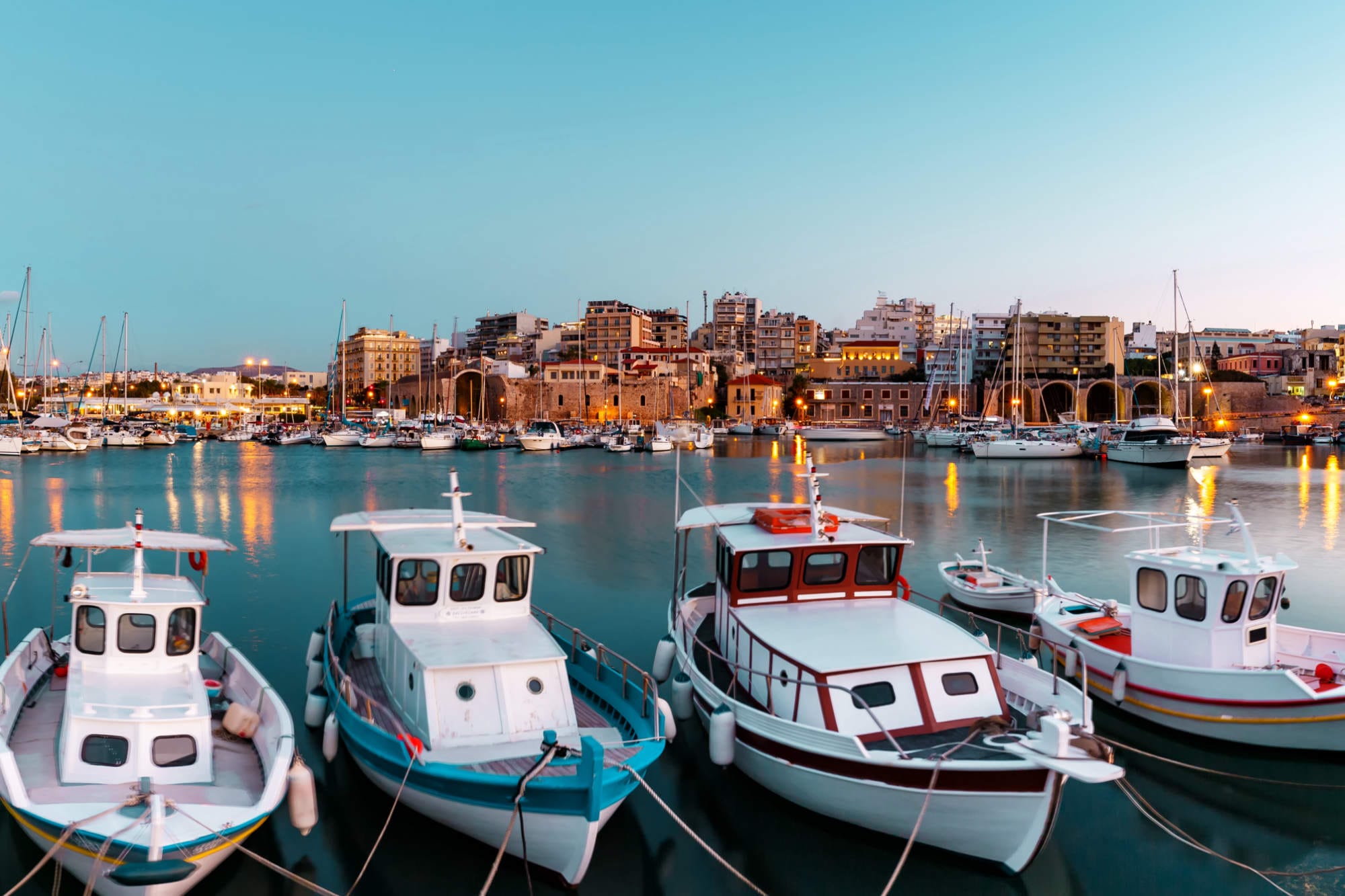
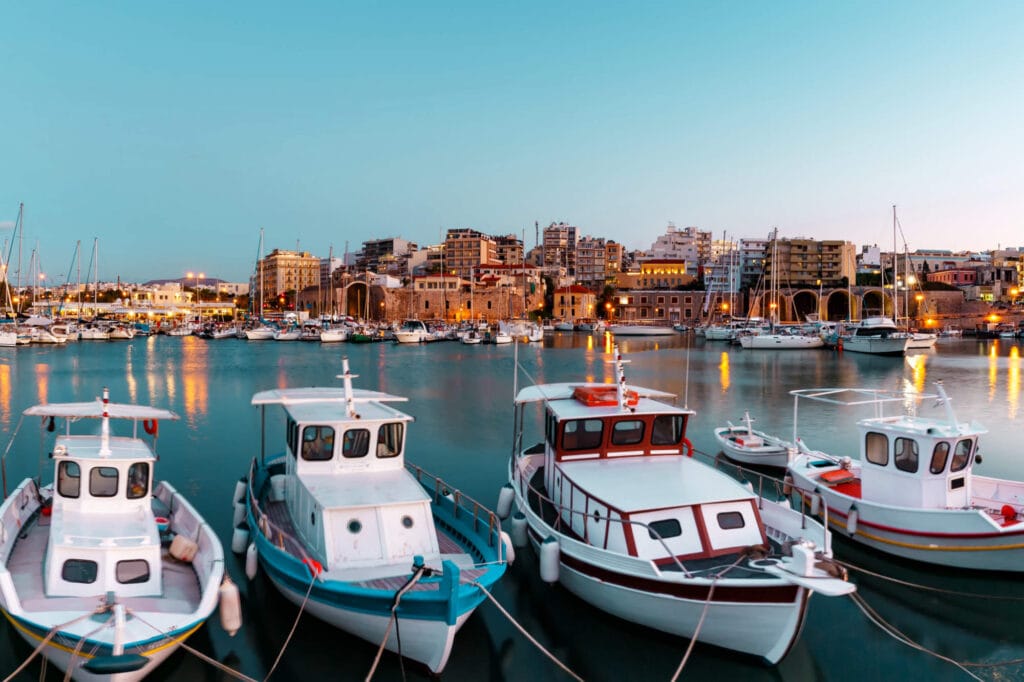
Heraklion’s old harbor is the heart of the city’s social life. The Venetian-era Koules Fortress sits at the end of the breakwater — you can walk out to it and enjoy sweeping views back over the city. The harbor itself is lined with seafood restaurants and bars that fill up from late afternoon onward.
The fortress is open to visitors and has rotating exhibitions inside. Sunset here is genuinely spectacular.
Eleftherias Square & the City Center
The main square is where Heraklion breathes. Surrounded by cafés and framed by palm trees, it’s the natural gathering point at any hour. From here, the pedestrianized 1866 Street (the city’s market street) leads down to the central market, where vendors sell local honey, herbs, olive oil, and Cretan cheeses.
Walk the street early in the morning when it’s at its most atmospheric and the locals are doing their actual shopping.
The Venetian Walls & Martinengo Bastion
The massive Venetian fortifications that ring the old city are among the best-preserved in Europe. The walls are wide enough to walk along the top in sections, and the Martinengo Bastion — where the Cretan author Nikos Kazantzakis is buried — offers a quiet elevated perspective over the city. His gravestone inscription is worth seeking out: ‘I hope for nothing. I fear nothing. I am free.’
Morosini Fountain & the Old Streets
The 17th-century Morosini Fountain sits in Liontos Square — one of the most charming corners of the city. The surrounding streets of the old town are full of independent cafés, small bookshops, and neoclassical buildings that give Heraklion a character distinct from the whitewashed island aesthetic most people expect from Crete.
Knossos Palace: What to Know Before You Go
No visit to Heraklion is complete without Knossos — the ceremonial and political center of Minoan civilization, inhabited from roughly 7000 BC and at its peak around 1700–1400 BC. This is the largest Bronze Age archaeological site on Crete, and one of the most visited ancient sites in all of Greece.
Getting There
Knossos is just 5 km south of the city center. You can reach it by city bus (Bus 2 from Eleftherias Square, runs frequently, very cheap), by taxi (around €10–12), or on foot if you’re keen (45–50 minutes). Renting a car is overkill for this specific trip since parking near the site is limited.
What to See
The site is large and partially reconstructed — controversially so, since the early 20th-century restorer Arthur Evans made interpretive choices that some archaeologists dispute. Regardless, the reconstructions help visitors imagine the scale and complexity of this palace: multi-story buildings, elaborate drainage systems, storerooms that held hundreds of enormous clay jars (pithoi), and ceremonial halls decorated with vivid frescoes.
Key highlights: the Throne Room (one of the oldest thrones in Europe), the Grand Staircase, the Queen’s Megaron, and the storage magazines.
Practical Tips for Knossos
- Arrive early (opening time is best — crowds build fast after 10am)
- Buy the combined ticket with the Archaeological Museum — it saves money and the two sites work perfectly together
- Hire a licensed guide or download an audio guide — the site is hard to interpret without context
- Wear good shoes and bring sun protection; the site is exposed and you’ll walk 2–3 km
- Allow 1.5–2 hours minimum
The Best Neighborhoods to Explore
The Old Town (Historic Center)
The area inside the Venetian walls is where most of Heraklion’s character lives. It’s walkable, slightly chaotic, and full of small squares, churches, and local shops. This is where you should base yourself if you want to be in the middle of everything.
Koronaiou Square Area
This is the local food and nightlife hub — a cluster of squares and pedestrian streets just east of Eleftherias where Cretans actually eat dinner. Less touristy than the harbor, and the food quality is consistently high.
Ammoudara Beach (Western Suburb)
If you need a beach break, Ammoudara is Heraklion’s nearest option — a long sandy stretch about 4 km west of the center, connected by bus. It’s functional rather than beautiful, but fine for an afternoon dip. For proper Cretan beaches, head east toward Malia or west toward Rethymno.
Where to Eat & Drink in Heraklion
Cretan cuisine is widely considered the best in Greece — and Heraklion is where it shows up in its most refined form. The foundation is simple: excellent local olive oil, wild herbs, aged graviera cheese, slow-braised lamb, and snails cooked in vinegar and rosemary. Here’s what to look for:
What to Order
- Dakos — the Cretan bruschetta: twice-baked barley rusk topped with tomato, olive oil, and mizithra cheese
- Kalitsounia — small fried or baked pastries filled with soft white cheese and honey
- Staka — a rich, buttery cream from sheep’s milk, served warm with bread or eggs
- Lamb with stamnagathi — local wild greens braised with olive oil and lemon
- Raki — the local spirit, served cold as a digestif at the end of every meal, usually free
Where to Eat
The Koronaiou and Plateia Koronaiou area is the best hunting ground. Look for small family-run restaurants (tavernas) with handwritten menus and no photos on the board. Heraklion’s central market (1866 Street) has excellent small shops to pick up provisions — local cheeses, olives, and honey make the best souvenirs.
The harbor area has options but leans more touristy. Perfectly fine for lunch with a view; for dinner, push into the old town streets.
Day Trips from Heraklion
Heraklion’s central position on Crete’s northern coast makes it the ideal base for exploring the island.
Rethymno — 1 Hour West
Crete’s most beautifully preserved Venetian old town, with a stunning fortress and a long sandy beach. An easy drive or bus ride west of Heraklion, and one of the most photogenic cities in Greece.
Elounda & Spinalonga — 1.5 Hours East
Elounda is one of Crete’s most exclusive resort areas, and nearby Spinalonga Island — a former Venetian fortress and later a leper colony — is one of the most visited sites in Crete. Boats run regularly from Elounda.
Matala & South Coast — 1.5 Hours South
The drive south through the Messara plain to Matala is a journey through the agricultural heartland of Crete. Matala itself has famous sea caves carved into the cliffs and a more relaxed, bohemian atmosphere than the north coast resorts.
Zaros & Mount Ida — 1 Hour South
For those who want to escape the coast entirely, the village of Zaros sits at the foot of Mount Ida (Crete’s highest peak) and offers a gorge walk, freshwater lake, trout restaurants, and a completely different side of Cretan life.
For a full overview of Crete’s regions and beaches, see our complete Crete Travel Guide.
How to Get Around Heraklion
The city center is walkable — most of the major sights are within a 20-minute walk of each other. For day trips and getting around Crete more broadly, a rental car is by far the most practical option.
City Buses
The KTEL bus system connects Heraklion to all major towns across Crete. The main bus station (KTEL) is located near the port. Buses are affordable, reliable, and the right choice for trips to Rethymno, Chania, and Agios Nikolaos.
Car Rental
Renting a car is the single best decision you can make for exploring Crete beyond the city. Heraklion has plenty of rental options at the airport and in the city center — book in advance for summer travel when availability tightens quickly.
Taxis & Rideshare
Taxis are plentiful and metered. The Beat app operates in Heraklion and is useful for clear pricing. For short trips within the city (harbor to museum, museum to Knossos), taxis are convenient.
Ferry
Heraklion’s port is Crete’s main ferry hub, with overnight connections to Piraeus (Athens), and routes to Santorini, Mykonos, and Rhodes. If you’re combining Crete with other islands, Heraklion is your natural departure point.
For complete transportation details, see our guide to Getting Around Greece.
Where to Stay in Heraklion
Most tourists don’t stay in Heraklion — which means you’ll find better value and less competition for accommodation than in resort areas like Elounda or Chania.
Old Town (Best for First-Timers)
Staying inside the Venetian walls puts you within walking distance of every major sight. Look for boutique hotels and renovated Venetian buildings that have been converted into accommodation — they tend to have more character than the chain hotels near the port.
Harbor Area
Hotels near the Venetian harbor offer excellent access to the ferry port (useful if you’re taking an early morning departure) and evening restaurant access. Slightly more expensive than old town options.
Airport Vicinity
If you’re flying in late and out early, a hotel near the airport makes logistical sense. Less atmosphere, but practical for transit nights.
Practical Tips for Visiting Heraklion
- Best time to visit: May–June and September–October avoid the peak summer crowds while keeping good weather
- The Archaeological Museum and Knossos combined ticket is the best value — buy it at either location
- Most restaurants don’t open for dinner until 8pm; don’t arrive expecting Greek hospitality at 6:30pm
- The city gets genuinely hot in July and August — midday sightseeing is uncomfortable; plan early mornings and evenings
- Cash is still useful at the central market; most restaurants and shops accept cards
- The city center is hilly in places — comfortable shoes matter more than at beach destinations
- Sunday mornings are quiet in a pleasant way; the market is closed but the cafés are full of locals
Explore More About Crete & Greek Cities
- Crete Travel Guide: The Ultimate Island Adventure
- Crete with Kids: A Family-Friendly Guide
- Best Beaches in Crete: From Elounda to Falasarna
- 7 Days in Crete: A Complete Island Itinerary
- Athens Travel Guide: Everything You Need to Know
- Getting Around Greece: Ferries, Flights & Cars
FAQ: Heraklion Travel Guide
Is Heraklion worth visiting, or should I go straight to the beaches?
Heraklion is absolutely worth at least one full day — ideally two. The Archaeological Museum and Knossos together represent one of the most significant ancient civilizations in European history, and the city’s food scene and Venetian architecture are genuinely compelling. Most visitors who skip it regret it once they see what they missed.
How much time do I need in Heraklion?
One full day is the minimum: morning at the Archaeological Museum, afternoon at Knossos, evening in the old town. Two days lets you explore at a more relaxed pace and include the harbor, Venetian walls, and a proper meal in the Koronaiou area.
How far is Knossos from Heraklion city center?
Knossos is 5 km south of the city center — about a 10-minute taxi ride or 15-minute bus journey on Bus 2 from Eleftherias Square. There’s no need to rent a car specifically for Knossos.
What is Heraklion known for?
Heraklion is known primarily for the Palace of Knossos (the center of ancient Minoan civilization), the world-class Archaeological Museum, its Venetian fortifications and harbor, and Cretan cuisine. It’s the largest city in Crete and the island’s main transportation hub.
Is Heraklion safe for tourists?
Yes — Heraklion is a busy, well-functioning city and very safe by any reasonable standard. Normal urban awareness applies (watch your belongings in crowded areas), but there’s no specific concern for tourists.
Can I visit Knossos without a guide?
You can, but a guide makes a significant difference. Knossos without context can feel like a series of half-ruined walls. A licensed guide or detailed audio guide brings the Minoan world to life and makes the visit far more rewarding. Guided tours depart regularly from Heraklion city center.
What’s the best way to get from Heraklion airport to the city center?
The airport is about 4 km east of the city center. A taxi costs around €10–15 and takes 10–15 minutes depending on traffic. City Bus 1 also connects the airport to Eleftherias Square and is very cheap. There’s no shuttle service, but the distance makes a taxi very affordable.
How do I get from Heraklion to other parts of Crete?
KTEL buses run frequently along the northern highway to Rethymno, Chania, and Agios Nikolaos. For more flexibility — especially for reaching south coast villages and beaches — a rental car is the better option.
Ready to Explore Heraklion?
Heraklion rewards the curious traveler. Spend a day or two in the city before continuing to the rest of Crete, and you’ll leave with a deeper appreciation for everything the island has to offer — from its ancient roots to its modern food culture.