Best Day Trips from Athens: Delphi, Meteora, Cape Sounion & More
Athens sits at the center of a landscape that reads like a catalogue of the ancient world. Within a two-hour drive in almost any direction, you can stand at the oracle’s seat in Delphi, watch the sun set over the Aegean from a clifftop temple at Cape Sounion, or look up at Byzantine monasteries balanced on the edge of rock pillars in Meteora. These aren’t detours — they’re some of the most extraordinary places in Greece.
The city makes an excellent base. The road and rail network radiating out from Athens is the most developed in Greece, and the concentration of major sites within day-trip range is unmatched anywhere else in the country. You could spend a full week based in Athens and fill every day with something genuinely significant.
This guide covers the best day trips from Athens — what each destination offers, how long it takes to get there, how to do it independently or on a tour, and which ones are worth the effort versus which ones are better saved for a longer trip.
*Note: This page contains affiliate links. We may earn a small commission at no extra cost to you when you book through our links. This helps us keep creating free travel guides.*
Day Trips from Athens at a Glance
- Cape Sounion — 70 km, 1.5 hours (easiest half-day)
- Delphi — 180 km, 2.5 hours (full day essential)
- Meteora — 330 km, 4 hours (best as overnight; doable as long day)
- Corinth & Mycenae — 80–90 km, 1–1.5 hours
- Epidaurus & Nafplio — 150 km, 2 hours
- Hydra Island — 2 hours by hydrofoil
- Marathon & Rhamnous — 42 km, 45 minutes
Cape Sounion: The Temple at the Edge of the World
Cape Sounion is the easiest and most rewarding half-day trip from Athens — and the one we’d recommend to anyone with even a few hours to spare. At the southernmost tip of the Attica peninsula, 70 km from the city center, the Temple of Poseidon stands on a clifftop 60 meters above the Aegean Sea. The setting is dramatic in a way that photographs struggle to capture: white marble columns against blue water and open sky, with the islands of the Saronic Gulf scattered on the horizon.
The temple was built in the 5th century BC, around the same time as the Parthenon, as a landmark for sailors returning to Athens. Lord Byron, who visited in the early 19th century, carved his name into a column — a piece of historical graffiti that has become part of the site’s story. On a clear day the view extends to Aegina, Kea, and Serifos.
Getting There
The coastal road from Athens to Cape Sounion is one of the most scenic drives in Attica — 70 km along the Saronic coast, passing through the beach towns of Glyfada, Vouliagmeni, and Varkiza. Allow 1.5 hours from central Athens in normal traffic.
- By car: the easiest option, giving you the flexibility to stop at beaches on the way back
- By bus: KTEL buses depart regularly from the Pedion tou Areos terminal in central Athens — the coastal route takes about 2 hours and is scenic
- By organized tour: half-day tours from Athens are widely available and include round-trip transport
What to See
The Temple of Poseidon is the main draw, but allow time to walk the full site — the remains of a smaller temple to Athena are nearby, and the clifftop paths offer different perspectives over the water. Sunset is the most popular time to visit, and for good reason: the light on the columns in the hour before dusk is genuinely spectacular.
The site has a café and basic facilities. Admission is charged (around €10). Combined tickets with other Attica sites are sometimes available.
Practical Tips
- Arrive 90 minutes before sunset for the best light and manageable crowds
- The site is exposed — bring sun protection and water in summer
- The coastal road back to Athens via the inland route (through Lavrio) is faster if traffic is heavy
- Vouliagmeni Lake — a natural thermal lake 40 km before Sounion — is worth a stop if you have time
Delphi: The Navel of the Ancient World
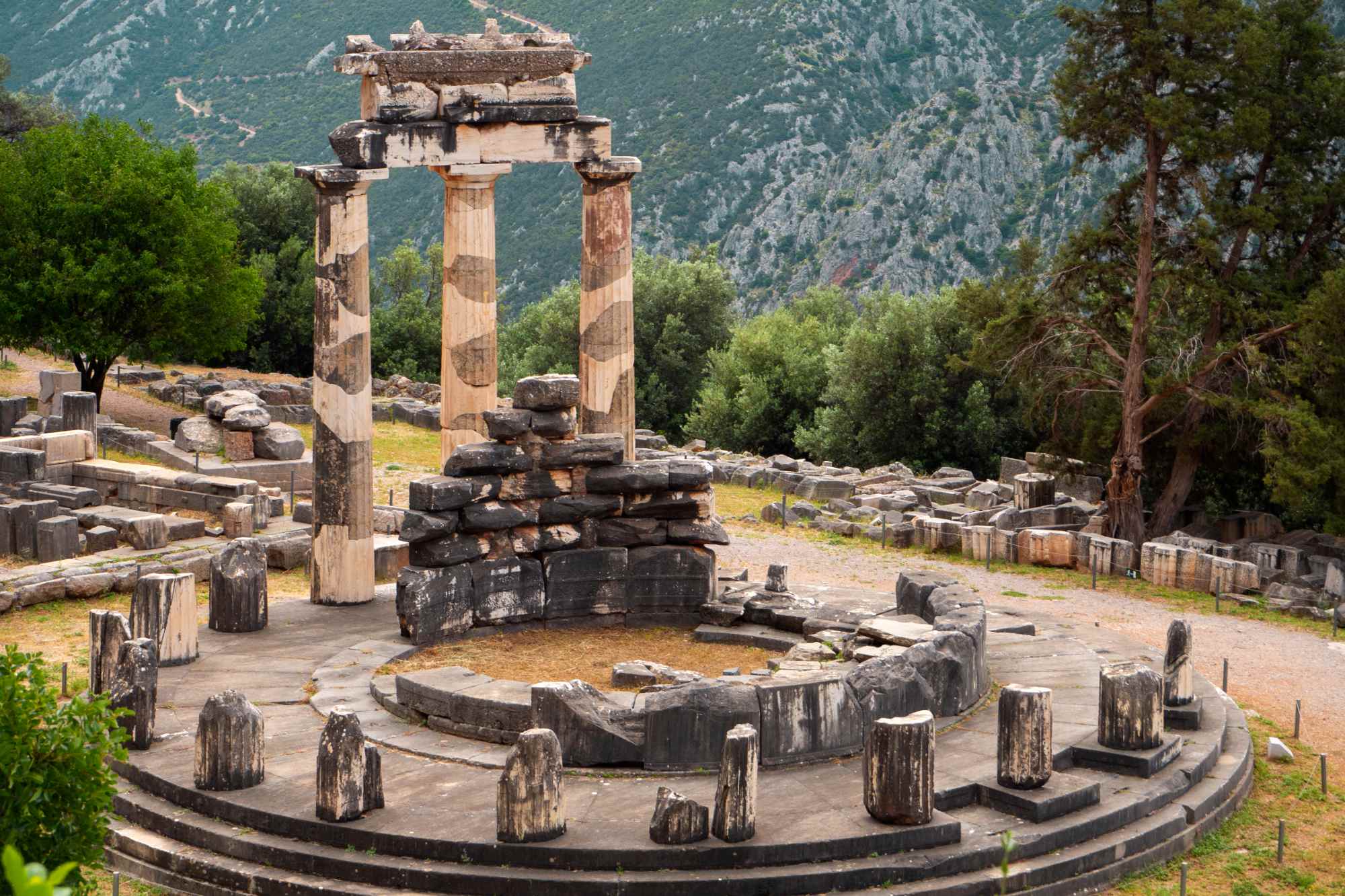
No day trip from Athens carries more historical weight than Delphi. For nearly a thousand years — from roughly the 8th century BC to the 4th century AD — this mountain sanctuary was the most important religious site in the Greek world. Kings, generals, and city-states came here to consult the Oracle of Apollo before any major decision. The city of Delphi grew up around the sanctuary and became fabulously wealthy from the offerings of petitioners.
The site sits on the southern slopes of Mount Parnassus at about 570 meters elevation, in a landscape of extraordinary drama — steep cliffs, olive groves rolling down to the Pleistos valley, and the Gulf of Corinth glittering far below. Even stripped of its ancient meaning, it’s one of the most beautiful places in Greece.
Getting There
Delphi is 180 km northwest of Athens — about 2.5 hours by car via the E65 motorway through Levadia. It’s one of the longer day trips in this guide, so an early start is important.
- By car: the most flexible option; the drive through Boeotia and the Parnassus foothills is scenic
- By bus: KTEL buses run from the Liosion terminal in Athens to Delphi — the journey takes about 3 hours
- By organized tour: full-day guided tours from Athens are available and include transport, a guide at the site, and sometimes lunch
What to See
The Archaeological Site
The site is large and spread across a steep hillside — allow a minimum of two hours and preferably three. Key monuments include:
- The Sacred Way — the processional road that wound up through the sanctuary, lined with treasuries and monuments from city-states across the Greek world
- The Temple of Apollo — the heart of the sanctuary, where the Pythia (the Oracle) delivered her pronouncements from a chamber above a fissure in the rock
- The Theatre — a well-preserved 4th-century BC theatre with sweeping views down the valley
- The Stadium — the best-preserved ancient stadium in Greece, where the Pythian Games (forerunner of the Olympics) were held every four years
The Delphi Museum
The on-site museum is essential and often underestimated. It holds the finest collection of archaic Greek sculpture outside Athens, including the Charioteer of Delphi — a bronze statue from 478 BC of such technical perfection that it stops people in their tracks. The Sphinx of Naxos, the frieze from the Siphnian Treasury, and the twin statues of Cleobis and Biton are equally remarkable. Build at least 90 minutes for the museum.
Practical Tips for Delphi
- Start early — leave Athens by 7:30–8am to arrive when the site opens and before the tour groups
- Buy the combined ticket covering both the site and the museum — it’s significantly better value
- The village of Delphi (a short walk from the site) has excellent tavernas for lunch — try the local lamb dishes
- Arachova, 10 km east of Delphi on the slopes of Parnassus, is worth a stop for local cheese, pasta, and mountain village atmosphere
- If you’re driving, the return via Distomo and Lake Yliki offers a different and scenic route
Meteora: Monasteries on the Rocks
Meteora is, in the simplest terms, one of the most visually astonishing places in Europe. The monasteries of Meteora — six of them still active, perched atop a cluster of sandstone pillars that rise abruptly from the Thessalian plain — look like something from a fantasy novel. The rock formations themselves were shaped by geological forces over 60 million years. The monasteries were built, largely in the 14th and 15th centuries, by monks who chose these inaccessible pinnacles precisely because they were impossible to reach without ropes and nets.
Today, carved staircases and roads make the monasteries accessible, and they receive hundreds of thousands of visitors a year. The experience — standing on a rock platform at 400 meters, looking across a landscape of vertical stone towers to the monasteries opposite — remains genuinely overwhelming regardless of the crowds.
Meteora as a Day Trip vs Overnight
Meteora is 330 km from Athens — about 4 hours by car or train. It’s technically doable as a very long day trip (leave Athens by 6am, return after 10pm), but doing it this way means you spend eight hours driving for five or six hours at the destination. Most travelers who attempt it report arriving tired and leaving rushed.
The better option is to treat Meteora as an overnight trip: one night in the town of Kalambaka at the base of the rocks, with a full morning for the monasteries (the light is best early) and an afternoon at leisure. The return to Athens takes the same 4 hours, but you arrive having actually absorbed the place.
That said, organized tours from Athens that include transport, a guide, and a full day at the site are a legitimate option if two days aren’t available — they handle the logistics and a good guide transforms the experience.
Getting There
- By car: 4 hours via the E75 motorway to Larissa, then west to Kalambaka — the most flexible option
- By train: direct Intercity trains run from Athens Larissa Station to Kalambaka — around 4.5 hours, scenic through Thessaly
- By organized tour: full-day and overnight tours from Athens are available; the overnight versions are worth the extra cost
Which Monasteries to Visit
Six monasteries are open to visitors, though not all on the same days — check current opening schedules before you go. The most visited are:
- Megalo Meteoro (Great Meteoron) — the largest and highest monastery, with an excellent museum of Byzantine manuscripts and artifacts
- Varlaam — the second-largest, with remarkable 16th-century frescoes in the church
- Roussanou — the most photogenic from the outside, perched on a narrow pinnacle; now a convent
- Agia Triada (Holy Trinity) — used in the James Bond film For Your Eyes Only; the most isolated and atmospheric
Practical Tips for Meteora
- Dress code is strictly enforced: shoulders and knees must be covered for both men and women; wraps are sometimes available at the entrance
- Most monasteries close for a midday break (roughly 1–3pm) — plan your visits around this
- The best photography light is in the early morning — if staying overnight, be at the viewpoints by 7am
- The village of Kastraki, just below the rocks, is quieter and more atmospheric than Kalambaka for an overnight stay
- The rocks can be slippery when wet — sturdy shoes matter
Corinth & Mycenae: Bronze Age Power and Ancient Commerce
The Peloponnese — the large peninsula that hangs below central Greece — is separated from Attica by the Corinth Canal, an extraordinary 19th-century engineering feat that cut through 6 km of solid rock to connect the Aegean and Ionian seas. Crossing the canal is one of the memorable moments of any drive southwest from Athens.
Ancient Corinth
Ancient Corinth, 80 km from Athens, was one of the wealthiest and most strategically important cities of the ancient world — controlling trade between mainland Greece and the Peloponnese. The archaeological site includes the remains of the Roman-era city (the Greeks were fond of saying that only the rich could afford to visit Corinth), a museum of considerable quality, and the Temple of Apollo — seven columns still standing from the 6th century BC, among the oldest surviving Doric columns in Greece.
Mycenae
Twenty kilometers further into the Peloponnese, Mycenae was the center of the Bronze Age civilization that Homer described in the Iliad — the kingdom of Agamemnon, who led the Greek expedition to Troy. The site, discovered by Heinrich Schliemann in the 1870s, includes the famous Lion Gate (the oldest monumental sculpture in Europe), the Royal Graves where Schliemann found extraordinary gold treasures, and the massive Cyclopean walls that gave rise to the legend that only giants could have built them.
Corinth and Mycenae are usually combined into a single day trip, with Ancient Corinth in the morning and Mycenae in the afternoon. The drive from Athens via the coastal motorway is easy and pleasant.
Epidaurus & Nafplio: The Perfect Peloponnese Combination
If Mycenae represents the Bronze Age, Epidaurus is the ancient world at its most civilized. The Sanctuary of Asclepius at Epidaurus was the most famous healing center of antiquity — a kind of ancient spa and hospital complex where the sick came to seek the god’s cure through sleep, ritual, and (remarkably effective) herbal medicine.
The site’s enduring fame rests on its theatre — the best-preserved ancient theatre in Greece, with acoustics so precise that a whisper on stage can be heard in the back row of 14,000 seats. The theatre still hosts performances during the summer Epidaurus Festival; attending a performance here is one of the great experiences in Greece.
Nafplio
Thirty kilometers from Epidaurus, Nafplio is arguably the most beautiful small town in mainland Greece — a former capital of modern Greece (briefly, in the early 19th century) with an impeccably preserved Venetian old town, a hilltop fortress, and a waterfront that delivers exactly the kind of elegance that the islands are famous for but rarely found on the mainland.
The combination of Epidaurus in the morning and Nafplio for the afternoon and early evening is close to perfect: archaeological depth followed by a long lunch on the waterfront and a walk up to Palamidi Fortress for sunset views over the Argolic Gulf.
Getting There
Nafplio is 150 km from Athens — about 2 hours by car via the Corinth motorway. Buses run from KTEL Kifissos terminal in Athens. The trip is best done by car for the flexibility to combine both sites.
Hydra: An Island Day Trip Without the Crowds
Hydra is one of the Saronic Gulf islands, reached by hydrofoil from Piraeus (Athens’ main port) in about two hours. It’s included in this guide because, unlike the Cycladic islands, Hydra is genuinely accessible as a day trip — and it offers something completely different from the mainland sites.
Hydra is famously car-free. Not just low-traffic — entirely car-free. The only transport on the island is by donkey, water taxi, or foot. The harbor village is strikingly handsome, with 18th-century stone mansions climbing the hillside, and the island beyond is pure, rugged Aegean countryside with excellent hiking trails and remote swimming spots.
It’s a day trip best suited to travelers who want a genuine island atmosphere without committing to a ferry journey to the Cyclades. Artists, writers, and musicians have been drawn to Hydra since the 1950s — there’s still a creative, slightly removed-from-the-world quality to the place.
Getting There
Hydrofoils and high-speed catamarans run several times daily from Piraeus Port to Hydra. The journey takes 1 hour 40 minutes on the fastest services. Book in advance in summer — the boats fill up, particularly on weekends.
Marathon: Where Western History Turned
Marathon is just 42 km northeast of Athens — the closest major historical site to the city, and the one with perhaps the most significant story. In 490 BC, an Athenian and Plataean force of roughly 10,000 men defeated a Persian army of perhaps 25,000 on this coastal plain, in a battle that effectively preserved Greek civilization from Eastern conquest. The runner sent to Athens with news of the victory ran the original marathon distance — and collapsed and died upon arrival. The marathon race derives directly from this moment.
The site today is quiet and unhurried — a refreshing contrast to the busier archaeological sites near Athens. The burial mound (Soros) of the 192 Athenians who died in the battle is still visible, and the small museum holds the funerary offerings found inside. The nearby town of Marathon has beaches that are popular with Athenians for a quick sea swim.
Marathon is best combined with a visit to the coastal archaeological site of Rhamnous (30 km further northeast), a virtually unexcavated ancient city with two temples overlooking the sea — one of the most atmospheric and uncrowded ancient sites near Athens.
Choosing the Right Day Trip: Quick Comparison
Here’s how the main day trips from Athens stack up against each other:
Half-Day Options (under 2 hours from Athens)
- Cape Sounion — best for scenery and a quick ancient site fix; ideal for late afternoons
- Marathon — best for history enthusiasts; combines with beach at Schinias
- Vouliagmeni Lake — not a historical site but a beautiful thermal lake 25 km from Athens, good for a half-day break
Full-Day Options (2–3 hours from Athens)
- Delphi — the most historically and culturally rewarding full-day trip from Athens; non-negotiable for history lovers
- Corinth + Mycenae — the best Peloponnese combination for Bronze Age and ancient Greek history
- Epidaurus + Nafplio — the best combination for anyone who wants theatre, archaeology, and a beautiful town in one day
- Hydra — the best option if you want island atmosphere without a full ferry journey
Best as Overnight Trips
- Meteora — the journey alone is 4 hours each way; the site rewards more than a rushed afternoon
- Nafplio (extended) — Nafplio and the wider Argolid deserve two days if you want to include Tiryns, Argos, and the coast
Explore More About Athens & Greece
- Athens Travel Guide: Everything You Need to Know
- Athens in 2–3 Days: The Perfect Itinerary
- 7 Days in Greece: The Perfect One-Week Itinerary
- Getting Around Greece: Ferries, Flights & Cars
- Best Tours & Excursions in Greece
- Greece Travel Tips for First-Time Visitors
FAQ: Day Trips from Athens
What is the best day trip from Athens?
Delphi is the most rewarding single day trip from Athens in terms of historical significance and scenery — the Oracle’s sanctuary on the slopes of Mount Parnassus is one of the most atmospheric ancient sites in the world. For something closer and easier, Cape Sounion is the best half-day option. For sheer visual drama, Meteora (better as an overnight) is in a category of its own.
Can you visit Meteora as a day trip from Athens?
Technically yes, but it requires a very early start and makes for an exhausting day — roughly 8 hours of driving for 5–6 hours at the site. Most travelers who attempt it wish they’d stayed overnight. If time is truly limited, an organized tour that handles the driving is the most sensible approach.
How far is Delphi from Athens?
Delphi is 180 km from Athens — approximately 2.5 hours by car via the E65 motorway, or about 3 hours by KTEL bus from the Liosion terminal. It’s a full-day trip; plan to leave Athens no later than 8am to arrive at opening time and have enough time for both the site and the museum.
Is Cape Sounion worth a day trip?
Cape Sounion is absolutely worth a half-day trip — the Temple of Poseidon on the clifftop above the Aegean is one of the most beautiful ancient sites near Athens, and the coastal drive to get there is scenic in its own right. The combination of late afternoon timing, sunset light on the columns, and views over the Saronic Gulf makes it one of the most memorable few hours you can spend near Athens.
What is the easiest day trip from Athens?
Cape Sounion is the easiest — it’s 70 km from Athens, accessible by public bus or car, and requires no advance booking for the site itself. Marathon is the closest at 42 km, but Cape Sounion offers a more visually dramatic payoff. Both can be done as half-day trips without an early start.
Do I need a guided tour for Delphi or Meteora?
You don’t need one — both sites are accessible independently and have good on-site signage and audio guides. That said, a knowledgeable guide makes a significant difference at Delphi in particular, where the mythological and historical layers are dense and not immediately obvious from the ruins alone. For Meteora, a guide is less essential — the monasteries speak for themselves — but adds useful context about the monastic tradition and the Byzantine history.
Can I visit Delphi and Meteora on the same trip?
They’re in opposite directions from Athens — Delphi is northwest, Meteora is north — but they can be combined on a longer road trip through central Greece. A practical route: Athens → Delphi (day 1) → Arachova overnight → Lamia → Meteora (day 2) → return to Athens (day 3). This is one of the most rewarding mainland Greece road trips available.
What should I wear to visit the monasteries at Meteora?
Dress code is enforced at all active Meteora monasteries: shoulders must be covered, and shorts are not permitted — long trousers or a skirt below the knee is required. This applies to all genders. Scarves or wraps are sometimes available at monastery entrances, but bringing your own is more reliable.
Ready to Explore Beyond Athens?
The ancient world around Athens is extraordinary — and most of it is within a day’s reach. Whether you have a single afternoon for Cape Sounion or a week to drive through the Peloponnese and central Greece, the mainland rewards every hour you give it.