Greece Ferry Guide: How to Book & Navigate the Islands by Sea
This Greece ferry guide covers more than logistics — the ferry is part of the experience itself. Standing on the deck of a large overnight ferry as the lights of Piraeus fade behind you and the open Aegean opens up ahead. Arriving at Santorini by sea for the first time, the black volcanic cliffs rising from the water before the white-washed clifftop villages come into view. Watching the fishermen at a small island harbour as your high-speed catamaran pulls in fifteen minutes ahead of schedule.
Greece has one of the most extensive ferry networks in the world. Dozens of companies, hundreds of routes, thousands of departures per week in peak season — connecting Athens to the islands, islands to each other, and the mainland to the Ionian chain. It is the circulatory system of Greek island travel, and once you understand how it works, it becomes one of the most flexible and enjoyable ways to move through the country.
This guide covers everything: the main ferry operators, how to read the routes, how to book tickets (and when), the different ticket classes and what they’re actually worth, plus the practical details that save you time and stress on travel days.
*Note: This page contains affiliate links. We may earn a small commission at no extra cost to you when you book through our links. This helps us keep creating free travel guides.*
How the Greek Ferry Network Works
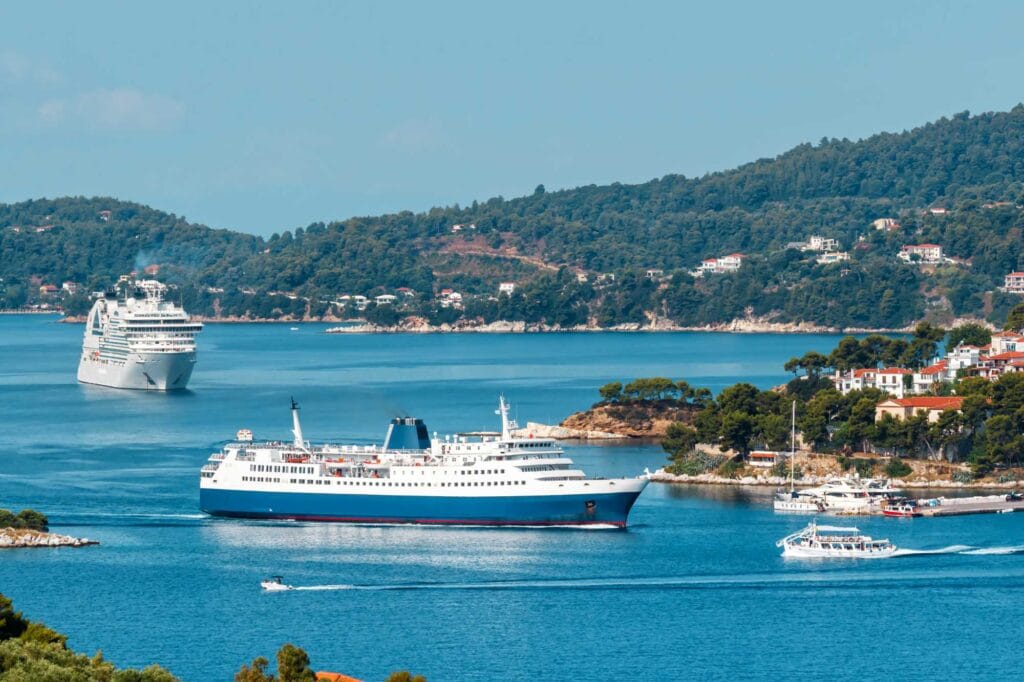
The Greek ferry network connects the mainland (primarily Athens via Piraeus port) to the islands, and the islands to each other. Understanding the basic structure makes navigating it much simpler.
The Hub System
The network operates on a hub-and-spoke model. The main hub is Piraeus — Athens’ port, the largest passenger port in Europe — which serves as the departure point for the majority of island routes. Secondary hubs include Rafina (northeast of Athens, closer to the Cyclades), Lavrio (for some Cyclades and eastern Aegean routes), Heraklion in Crete, and Patras for Ionian connections.
From these hubs, ferries fan out to island groups: the Cyclades (Santorini, Mykonos, Paros, Naxos etc.), the Dodecanese (Rhodes, Kos, Symi etc.), the Saronic islands (Aegina, Hydra, Spetses), the Northern Aegean (Lesbos, Chios, Samos), and the Sporades (Skiathos, Skopelos).
Two Types of Ferry Service
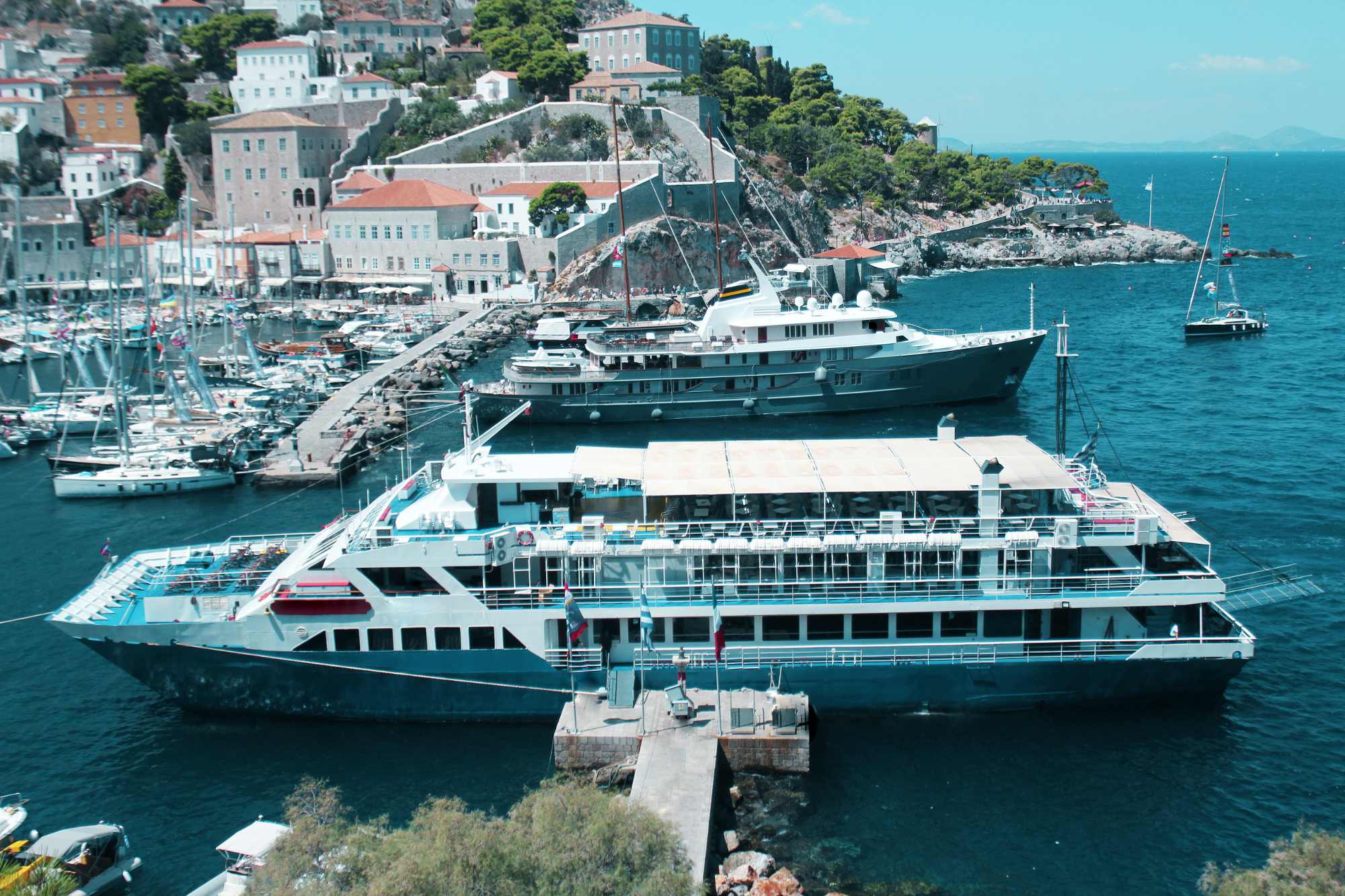
Conventional large ferries (also called slow ferries or overnight ferries): Large vessels with multiple decks, cabins, restaurants, and vehicle decks. Slower but more comfortable for overnight journeys. Journey times are longer but you arrive refreshed after sleeping. Example: Athens (Piraeus) to Heraklion — approximately 8–9 hours.
High-speed ferries and catamarans (also called fast ferries or Flying Cats): Smaller, faster vessels that cut journey times significantly but offer less comfort, no cabins, and a bumpier ride in rough seas. Generally more expensive. Example: Athens (Piraeus) to Santorini — approximately 5 hours by high-speed vs 8–9 hours by conventional ferry.
Seasonal Service
The Greek ferry network is heavily seasonal. Peak service runs from late May through early October — when most popular routes operate multiple daily departures. Outside this window, service drops significantly: some routes run 2–3 times per week, and some smaller island connections stop entirely. If you’re travelling in April, November, or winter, check schedules carefully and book early as fewer seats are available.
The Main Greek Ferry Operators
Multiple companies operate on Greek ferry routes, and on popular connections you’ll often have a choice between operators. Here are the main players worth knowing.
Blue Star Ferries
The largest conventional ferry operator in Greece and the most reliable for overnight routes. Covers the Cyclades, Dodecanese, and eastern Aegean with large, well-equipped vessels. Their Blue Star 1 and Blue Star 2 are among the most comfortable large ferries in the Greek network. Excellent for overnight journeys to Santorini, Mykonos, Rhodes, and Crete. Operated by Attica Group, the largest ferry group in Greece.
SeaJets
The dominant high-speed operator, running the fastest services across the Cyclades. Their Worldchampion Jet and similar vessels cut Athens-to-Santorini to around 5 hours. Good choice when you want daytime travel and prefer to arrive sooner rather than sleep aboard. Can be rough in strong winds — the high-speed hulls feel sea conditions more than the large conventional ferries.
Minoan Lines
Primarily known for the Athens (Piraeus) to Heraklion, Crete route — one of the busiest overnight ferry connections in Greece. Their vessels are large and well-maintained with good cabin options. A strong choice for the overnight Crete crossing.
ANEK Lines
Another major Crete operator, running the Piraeus to Heraklion and Piraeus to Chania routes. Often competitive on price with Minoan Lines on the same route. Also operates Adriatic routes (Greece to Italy) which matters for travellers arriving or departing overland.
Hellenic Seaways
Operates high-speed and conventional services on the Cyclades, Sporades, and Saronic Gulf. Their Flying Cat catamarans are popular for fast Cyclades hops. Good coverage of the Saronic islands (Hydra, Poros, Spetses) with multiple daily departures from Piraeus.
Golden Star Ferries
Smaller operator focusing on the Cyclades with competitive pricing. Worth comparing against Blue Star on overlapping routes.
Ionian Lines and Levante Ferries
Cover the western routes: Patras to Corfu and the Ionian Islands. Essential for travellers coming from Italy or planning an overland/sea combination through the Ionian chain.
| 💡 One booking platform, all operators: Rather than checking each company’s website individually, use a consolidated booking platform like Ferryscanner, Ferryhopper, or DirectFerries — these show all available operators and ticket classes for any given route on any date, making comparison straightforward. |
Key Ferry Routes and Journey Times
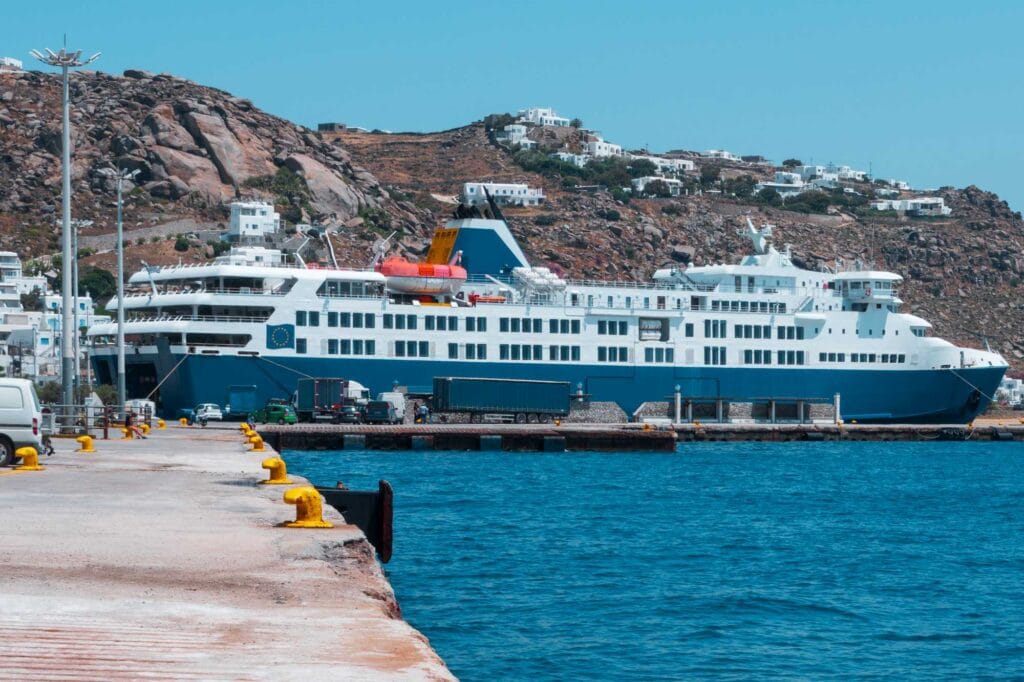
The following table covers the most-used ferry routes in Greece for travellers planning an island itinerary. Journey times are approximate and vary by vessel type (conventional vs high-speed).
| From | To | Approx. Duration | Main Operators |
| Piraeus (Athens) | Santorini | 5 hrs (fast) / 8–9 hrs (conventional) | SeaJets, Blue Star |
| Piraeus (Athens) | Mykonos | 3.5 hrs (fast) / 5–6 hrs (conventional) | SeaJets, Blue Star, Hellenic Seaways |
| Piraeus (Athens) | Paros | 3 hrs (fast) / 5 hrs (conventional) | SeaJets, Blue Star |
| Piraeus (Athens) | Naxos | 3.5 hrs (fast) / 5.5 hrs (conventional) | SeaJets, Blue Star |
| Piraeus (Athens) | Heraklion (Crete) | 8–9 hrs (overnight) | Minoan Lines, ANEK |
| Piraeus (Athens) | Chania (Crete) | 8–9 hrs (overnight) | ANEK Lines |
| Piraeus (Athens) | Rhodes | 12–18 hrs (conventional) | Blue Star, Dodekanisos |
| Piraeus (Athens) | Kos | 10–14 hrs (conventional) | Blue Star |
| Rafina (Athens) | Mykonos | 2.5 hrs (fast) / 4.5 hrs (conventional) | SeaJets, Blue Star |
| Rafina (Athens) | Santorini | 4.5 hrs (fast) | SeaJets |
| Santorini | Mykonos | 2 hrs (fast) / 3.5 hrs (conventional) | SeaJets, Blue Star |
| Santorini | Paros | 1.5 hrs (fast) | SeaJets, Blue Star |
| Mykonos | Paros | 45 min (fast) | SeaJets |
| Paros | Naxos | 35–45 min | Multiple operators |
| Piraeus (Athens) | Hydra (Saronic) | 1.5–2 hrs (conventional) | Hellenic Seaways |
| Patras | Corfu | 7–8 hrs (conventional) | Ionian Lines, Levante |
| Note: Journey times vary by vessel and conditions. Always check the specific schedule at time of booking — high-speed services only operate in suitable sea conditions and can be cancelled or substituted with conventional ferries in rough weather. |
Ferry Ticket Classes Explained
Greek ferries — particularly the large conventional overnight vessels — offer several ticket categories. Understanding what each actually gets you prevents the common mistake of either overpaying for unnecessary comfort or underbuying and spending eight hours in a deck chair.
| ⚓ Deck Passage (No Seat Reserved) |
| Best for: Young travellers, short daytime journeys, budget travellers happy to find their own spot What you get: Access to the ferry’s common areas — seating lounges, outdoor decks, cafeteria. No reserved seat or berth. On overnight journeys, you sleep where you find space. Price range: Cheapest option — typically 30–50% less than airline-seat class |
| 💺 Airline-Seat Class (Economy Seat) |
| Best for: Daytime crossings, budget-conscious travellers who want a guaranteed seat What you get: A reserved reclining seat in an indoor lounge, similar to an economy airline seat. Air-conditioned. Suitable for journeys up to 6 hours. Not comfortable for overnight. Price range: Mid-range — the standard choice for most daytime travellers |
| 🛋️ Business / Pullman Class |
| Best for: Longer daytime journeys, travellers wanting more comfort without a cabin What you get: Wider, more reclinable seats in a quieter lounge area, sometimes with extra legroom and dedicated service. On some vessels, resembles a business-class cabin. Worth the small premium on journeys over 5 hours. Price range: Moderate premium above economy — typically €10–€25 more per person |
| 🛏️ Interior Cabin (2 or 4 berth) |
| Best for: Overnight journeys, couples, small groups who want a private sleeping space What you get: A small shared cabin with bunk beds, no porthole. Air-conditioned, lockable. Clean and functional — think budget hotel cabin. Transforms an overnight crossing into a genuine rest. Price range: €30–€70 per person above deck class for an overnight crossing |
| 🪟 Outside Cabin (2 or 4 berth) |
| Best for: Overnight journeys for travellers who want natural light and a sea view What you get: Same as interior cabin but with a porthole or window. Slightly more expensive but significantly better for anyone who finds windowless cabins uncomfortable. Worth the small premium. Price range: €10–€20 above interior cabin price — recommended for overnight trips |
| ⭐ Deluxe / Luxury Cabin |
| Best for: Special occasions, couples, travellers who want proper comfort on longer overnight routes What you get: Larger cabins with better furnishings, sometimes an ensuite bathroom, on some vessels. Genuinely comfortable and makes the Athens-Crete overnight feel like a short hotel stay. Price range: Variable — typically €80–€150 per person above deck class on the Athens-Crete route |
| Our recommendation for overnight journeys: book a 2-berth outside cabin. The cost difference vs deck passage is modest (€40–€80 per person), you arrive rested, and the cabin experience is genuinely enjoyable rather than something to survive. Daytime journeys of under 4 hours: deck passage or airline seat is perfectly comfortable. |
How to Book Ferry Tickets in Greece
Online Booking Platforms
The most convenient and reliable way to book Greek ferry tickets in advance is through a consolidated online platform. These aggregate all available routes, operators, and ticket classes in one search — saving the time of checking each company separately.
Ferryscanner — the most comprehensive platform for Greek ferries. Shows all operators and classes side by side, easy booking interface, instant confirmation. Best starting point for any Greek ferry search.
Ferryhopper — strong competitor to Ferryscanner with a clean interface and good coverage. Some users find the filtering slightly more intuitive. Worth comparing prices against Ferryscanner on the same route.
DirectFerries — broader international coverage alongside Greek routes. Useful if your itinerary includes ferry connections beyond Greece (Italy, Turkey).
Operator websites directly — Blue Star, SeaJets, Minoan, and other operators also sell directly. Occasionally prices match the aggregators, sometimes slightly cheaper for specific cabins. Worth checking if you have a specific vessel or operator in mind.
Booking at the Port
Booking tickets in person at the port is possible and sometimes convenient for last-minute decisions or routes you decide on once you arrive on an island. Most ports have ticket offices for the main operators within walking distance of the terminal.
The downside: popular routes in peak season sell out — particularly cabins on overnight ferries and seats on the best-timed high-speed departures. Walking up to the ticket window at Piraeus on a July Saturday morning hoping for a cabin to Santorini is not a reliable plan.
Via Local Travel Agents
Every Greek island has local travel agencies that sell ferry tickets alongside accommodation and tours. Convenient if you’re already on an island and want to book the next leg in person. Prices are the same as online — ferry tickets in Greece are sold at fixed tariff rates and agents charge no booking fee beyond the standard service charge.
When to Book Ferry Tickets — and When It’s Fine to Wait
Book in Advance For:
- Overnight journeys where you want a specific cabin type — 2-berth outside cabins on the Athens-Crete route sell out weeks ahead in July and August
- High-speed departures at popular times (morning and afternoon departures on peak routes like Piraeus-Santorini)
- Any ferry travel during Greek national holidays — Easter, the 15th of August (Assumption), and the beginning and end of Greek school summer holidays are the busiest periods on the entire network
- Travel on a Saturday in peak season — Greeks travelling to and from the islands fill boats that tourists assume will be empty
Fine to Book Last Minute or on Arrival:
- Deck passage or standard economy seats on conventional ferries (large capacity, rarely fully sold out)
- Shoulder season travel (May, June, September, October) when demand is lower
- Shorter hops between nearby islands with multiple daily departures (Paros to Naxos, for example)
- Travel mid-week in non-peak months
The general rule: if the specific ticket class or departure time matters to you, book in advance. If you’re flexible on timing and class, you can usually book closer to the date — or even on arrival.
The Main Ferry Ports
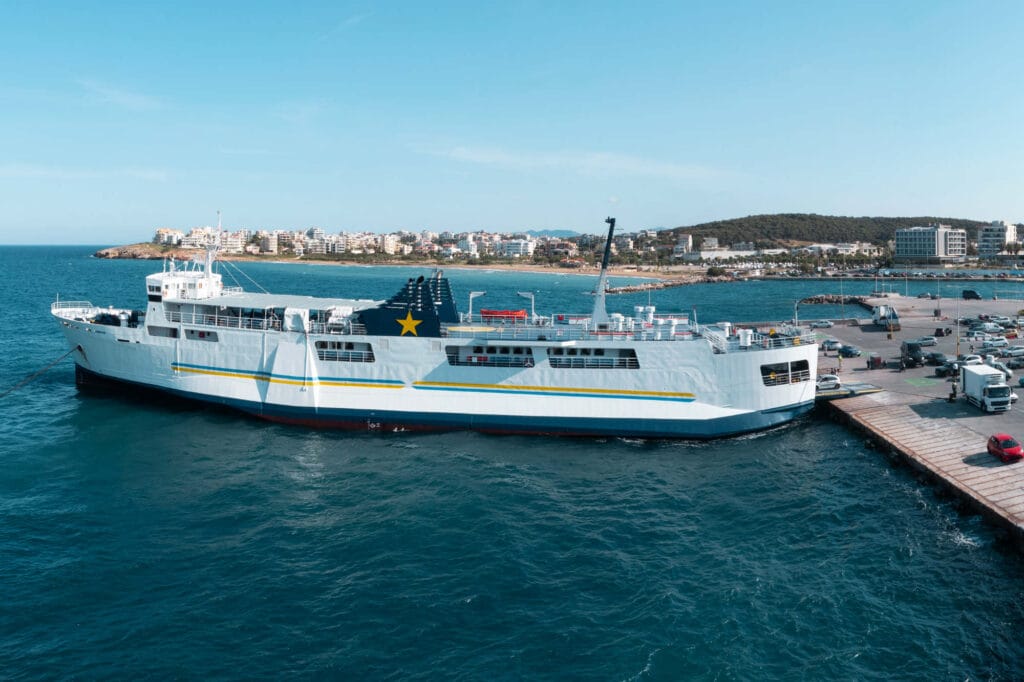
Piraeus — Athens’ Main Ferry Port
Piraeus is the largest passenger port in Europe and the hub of the Greek ferry network. It’s located approximately 10km southwest of central Athens and is easily reached by Metro (Line 1, Green line — Piraeus station, about 30 minutes from Syntagma Square). The port is large and can feel overwhelming on first visit: it’s divided into multiple gates (E1 through E12) serving different island groups. Your ticket will specify the gate — check it carefully and arrive at least 30 minutes before departure.
- Gates E1–E2: Saronic Islands (Aegina, Hydra, Poros, Spetses)
- Gates E3–E4: Cyclades conventional ferries and Crete
- Gates E5–E7: Cyclades and Dodecanese
- Gates E9–E10: Adriatic routes (Italy)
- Gates E11–E12: Crete, Dodecanese, and eastern Aegean
Allow extra time if it’s your first time at Piraeus, especially in peak season.
Rafina — The Underused Alternative for Cyclades
Rafina port, 35km northeast of Athens near the international airport, is significantly less chaotic than Piraeus and often faster for Cyclades travellers — journey times to Mykonos and Santorini are shorter from Rafina than from Piraeus. If you’re arriving at Athens International Airport and heading directly to a Cyclades island, check Rafina departures first — the port transfer is straightforward and the connections can save you 30–60 minutes of travel time each way.
Heraklion — Crete’s Main Port
The largest port in Crete, receiving overnight ferries from Piraeus daily. Located adjacent to Heraklion city centre — walking distance from the historic waterfront and the Venetian harbour. Well-organised, easy to navigate.
Rhodes Port
The main ferry terminal for Rhodes and gateway to the Dodecanese island group. Multiple weekly connections to Piraeus, Kos, Symi, and other Dodecanese islands. The port is in Rhodes Town, near the Old Town walls.
Patras — Gateway to the Ionian and Italy
Patras port on the Peloponnese northwest coast is the main terminal for Ionian Island connections and for ferries to Italy (Ancona, Bari, Venice, Brindisi). Important for overland travellers and those doing a Greece-Italy combination.
Overnight Ferries: What to Expect
The overnight ferry is one of the underappreciated pleasures of Greek island travel. Done right — with a decent cabin and the right mindset — it replaces a flight, a hotel night, and a morning transfer with a single booking that delivers you to your destination rested and already in the mood for the islands.
The Experience
Large overnight ferries typically depart Piraeus in the early evening (around 18:00–21:00) and arrive at their destination in the early morning (05:00–08:00). The vessels are large — some carry 2,000+ passengers and hundreds of vehicles. There are restaurants, cafeterias, bars, and seating lounges in addition to the cabins.
On deck after departure, watching the Athens lights recede as the ferry moves into open water, is one of the genuinely memorable moments of a Greek trip. Allow yourself time on deck before settling in.
What to Pack for the Journey
- Earplugs — ferries are not silent; there are announcements, other passengers, engine noise
- An eye mask — cabins and lounges are not fully dark
- A light layer — air conditioning can be aggressive
- Snacks — ferry cafeteria food is functional but uninspiring; bring something you’ll enjoy
- Entertainment for the stretch before sleeping — a book, downloaded shows, podcast
Arrival Times
Overnight ferries typically arrive between 05:00 and 08:00. Some island hotels will hold luggage from early arrivals but rooms won’t be ready until check-in time. Plan accordingly — arriving in Heraklion at 06:00 gives you a few hours to explore the city before your accommodation opens. It’s not a hardship: morning light in a Cretan harbour is worth experiencing.
Travelling with a Car on a Greek Ferry
Taking a car on a Greek ferry is common and well-organised. Most large ferries have vehicle decks that can carry passenger cars, motorcycles, campervans, and commercial vehicles.
How It Works
When booking, select the vehicle option in addition to your passenger ticket. You’ll be quoted a price for the car (based on length) plus the passenger fare. At the port, follow the signs to the vehicle lane — you queue separately from foot passengers and drive on board when directed by the crew. Vehicles are secured on the car deck during the crossing; access to the vehicle deck is generally restricted while at sea.
When It Makes Sense
Taking your car on a ferry makes most sense for longer stays on larger islands where you want the freedom of a vehicle — Crete, Rhodes, or Corfu are the main examples. For shorter hops between Cyclades islands, it’s almost never worth the additional cost and logistical complexity — renting a car on the island itself is simpler and usually cheaper.
Cost
Vehicle fares add significantly to the ferry ticket price. A standard car on the Piraeus-Heraklion overnight route, for example, adds approximately €80–€140 to the passenger fare. Motorcycles are cheaper (€20–€50 extra). Always get a full quote including the vehicle before committing.
Tips for a Smooth Ferry Journey in Greece
Arrive Early at the Port
Greek ferry departures are reasonably punctual — but boarding starts 45–60 minutes before departure and the best deck spots, seating, and restaurant tables go to those who board early. For large conventional ferries from Piraeus, aim to arrive at least 45 minutes before departure. For high-speed catamarans, 30 minutes is sufficient.
Confirm Your Gate at Piraeus
Piraeus has 12 gates spread across a large waterfront area. The gate for your specific departure will be on your ticket — check it before you arrive and head directly there. Walking the wrong direction along the Piraeus waterfront with luggage adds unnecessary time and stress.
High-Speed Ferries Can Be Cancelled in Bad Weather
Catamarans and high-speed vessels are more affected by rough seas than large conventional ferries. In the Aegean meltemi season (July–August), morning departures are often smoother than afternoon ones (wind typically builds through the day). If your high-speed ferry is cancelled due to weather, the operator will usually transfer you to the next available conventional ferry — account for this possibility in tight itineraries.
Book the Outward and Return Together
If you’re doing a round trip — Athens to Santorini and back, for example — book both legs at the same time. Return tickets are not always cheaper, but booking together guarantees your preferred times in both directions, which matters more than any small price difference.
Keep Your Ticket Accessible
Ferry tickets are checked at the port gate before boarding. Digital tickets on your phone work perfectly — screenshot it or download the PDF to avoid needing signal at the port. Port WiFi is unreliable.
Eat Before You Board — or Lower Your Expectations
Ferry cafeteria food in Greece is notoriously uninspiring: packaged sandwiches, instant coffee, microwaved toasties. On overnight journeys, the sit-down restaurant is often better but still functional rather than good. The right move: eat a proper meal before boarding, bring snacks you’ll enjoy, and treat the cafeteria as emergency backup only.
Check the Schedule the Night Before
Greek ferry schedules are published seasonally but individual departures can be modified due to weather, port congestion, or schedule changes. Check your departure time on the operator’s website or your booking platform the evening before travel — changes are not always communicated proactively.
Explore More: Plan Your Trip to Greece
Getting Around Greece: Ferries, Flights & Cars
Island Hopping in Greece: The Ultimate Guide
Yacht & Sailing Charters in Greece
Cyclades Island Hopping Itinerary
FAQ: Greece Ferries
How do I get from Athens to Santorini by ferry?
The main departure point is Piraeus port (Athens), with some services from Rafina (closer to the airport). High-speed ferries (SeaJets, Hellenic Seaways) take approximately 5 hours; conventional overnight ferries (Blue Star) take 8–9 hours. The high-speed option is the standard daytime choice for most travellers. Book in advance for July and August — peak summer departures at good times sell out. For a full guide to the Athens-Santorini connection, see our dedicated article.
Athens to Santorini: How to Plan the Perfect Trip
How far in advance should I book Greek ferry tickets?
For overnight cabin tickets in July and August: 3–6 weeks in advance, sometimes more for specific cabin types (2-berth outside cabins on the Crete route sell fast). For daytime high-speed services on popular routes (Athens-Santorini, Athens-Mykonos) in peak season: 1–3 weeks. For shoulder season travel or flexible deck/seat tickets: booking 1–2 weeks ahead is generally fine, and sometimes the day before works. The safest rule: once your travel dates are fixed, book the ferries.
Which is better — the fast ferry or the overnight ferry to the islands?
It depends on what you’re optimising for. The high-speed ferry gives you a daytime crossing with sea views and arrival in the afternoon — you keep the full day. The overnight ferry saves a hotel night, delivers you in the morning, and the experience of a night at sea has its own appeal. For Crete specifically, the overnight is widely preferred — the journey is too long to be comfortable as a daytime high-speed crossing, and arriving rested in Heraklion at 06:00 works well. For Santorini and Mykonos, both options work — daytime high-speed is more popular but overnight in a cabin is a genuinely good experience.
Can I bring a car on a Greek ferry?
Yes — most large conventional ferries have vehicle decks. Book the car space at the same time as your passenger ticket. Prices vary by vehicle size and route. Most useful for longer stays on larger islands (Crete, Rhodes, Corfu) where having a car makes a significant difference to your experience. For the Cyclades, renting on each island is usually more practical.
Is it possible to island hop by ferry without pre-booking?
In shoulder season (May, June, September, October): yes, with reasonable confidence. Deck tickets and standard seats are usually available on the day or with a day’s notice. In peak season (July-August): possible but risky for the popular routes, particularly for cabins, specific departure times, and travel around Greek national holidays. The smart approach: book your first and last ferry legs in advance, and keep the middle legs flexible — decide island by island once you’re moving.
What port do I use for Mykonos from Athens?
Both Piraeus and Rafina serve Mykonos. Rafina is worth choosing if you’re arriving at Athens International Airport — it’s only 20 minutes from the airport (vs 1+ hour to Piraeus), and journey times to Mykonos from Rafina are slightly shorter. Check departures from both ports when planning — sometimes a Rafina high-speed departure and a Piraeus conventional departure are within an hour of each other in total travel time door to door.
How do I get from Piraeus port to central Athens?
The Metro is the best option: Line 1 (Green line) connects Piraeus station directly to Monastiraki and Syntagma in central Athens in approximately 25–30 minutes. Trains run frequently throughout the day and evening. Taxis and rideshare apps (Beat is the Greek equivalent of Uber) are also available at the port exits — expect €15–€25 to central Athens depending on traffic. Avoid port taxis that approach you directly inside the terminal — use the official taxi rank or book via app.
Are Greek ferries reliable and on time?
For the most part, yes. Large conventional ferries on major routes (Piraeus to Crete, Piraeus to Rhodes) are generally punctual. High-speed ferries are more subject to weather-related delays and cancellations — particularly in July and August when the Aegean meltemi can create conditions that make small fast vessels unsafe. The conventional large-ferry network is more resilient to weather. If you have a tight connection (ferry then flight, for example), always build in buffer time and never book the last possible flight out of the island.
Ready to Book Your Greece Ferry Tickets?
Search all available routes, operators, and ticket classes in one place — compare times, prices, and cabin options for any island combination.