
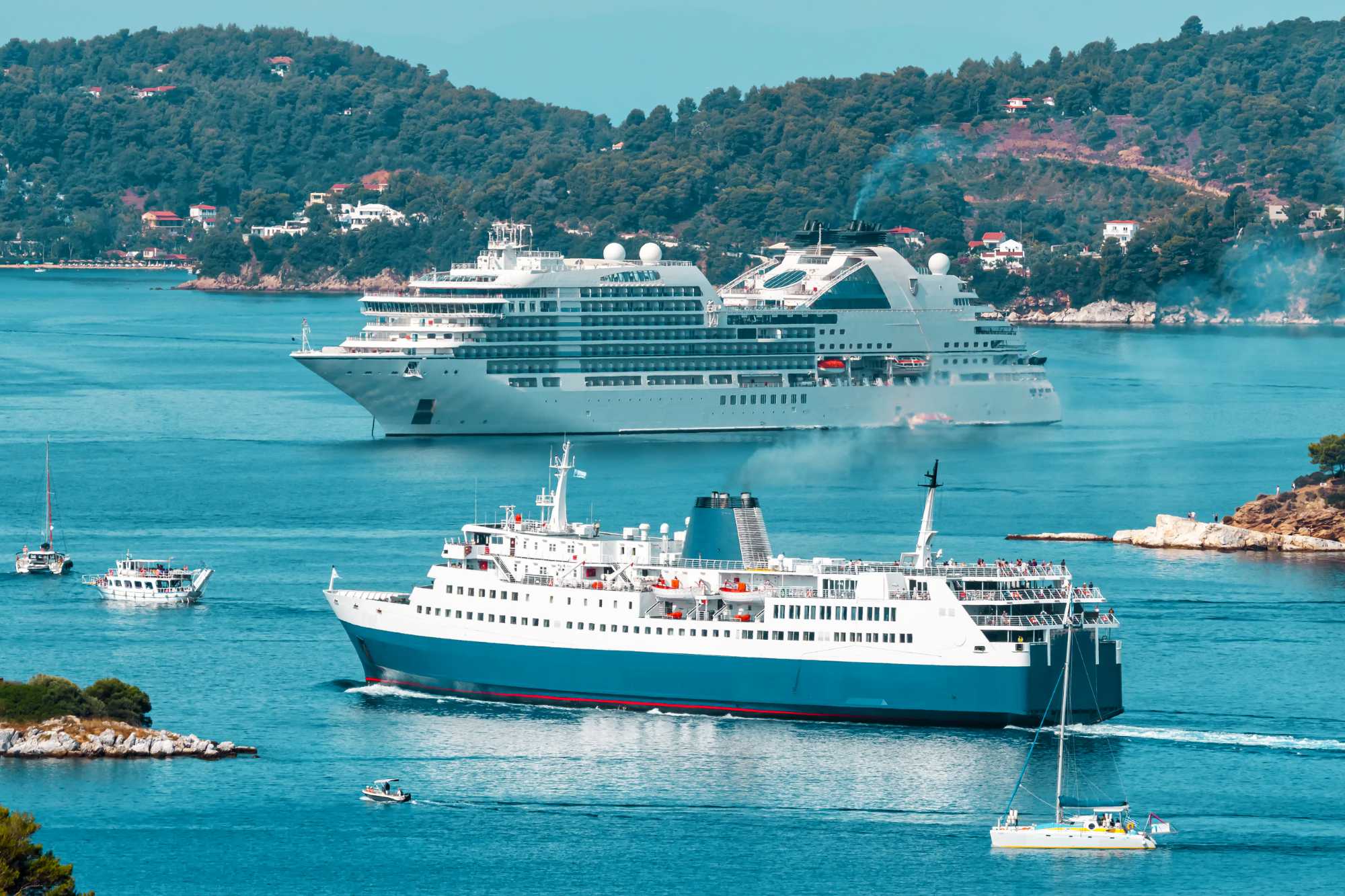
Getting Around Greece: Ferries, Flights & Car Rentals Explained
Greece is not one destination — it’s a country scattered across more than 200 inhabited islands, connected by a web of ferries, small airports, and coastal roads that rewards people who understand the system and frustrates those who don’t.
Getting around Greece efficiently comes down to three things: knowing which transport mode suits each leg of your trip, booking at the right time, and building enough flexibility into your schedule to absorb the occasional delay. A slow ferry, a Meltemi wind cancellation, a mountain road with no guardrails — Greece has its own rhythm, and the best trips are the ones that work with it.
This guide covers everything: ferries from port to island, domestic flights, car rentals, city transport, and the combinations that make multi-island trips run smoothly. No filler — just the practical information you need to get from A to B without unnecessary stress.
Transport at a Glance: Quick Comparison
Here’s how the main transport options stack up before we go into detail on each:
| Transport | Approx. Cost | Journey Time | Coverage | Alt. Row |
| Ferry (standard) | €20–60 | 5–12 hrs | Most islands | |
| Ferry (high-speed) | €45–90 | 2–6 hrs | Major islands | |
| Domestic flight | €40–120 | 30–55 min | 12+ airports | |
| Car rental (per day) | €30–80 | You drive | Everywhere | |
| Athens Metro | €1.20–9 | City-wide | Athens only | |
| Intercity bus (KTEL) | €5–25 | 1–5 hrs | Mainland |
The right choice always depends on your route, your time, and how much luggage you’re carrying. Most Greece trips use at least two or three of these options across the journey.
Ferries: The Backbone of Greek Island Travel
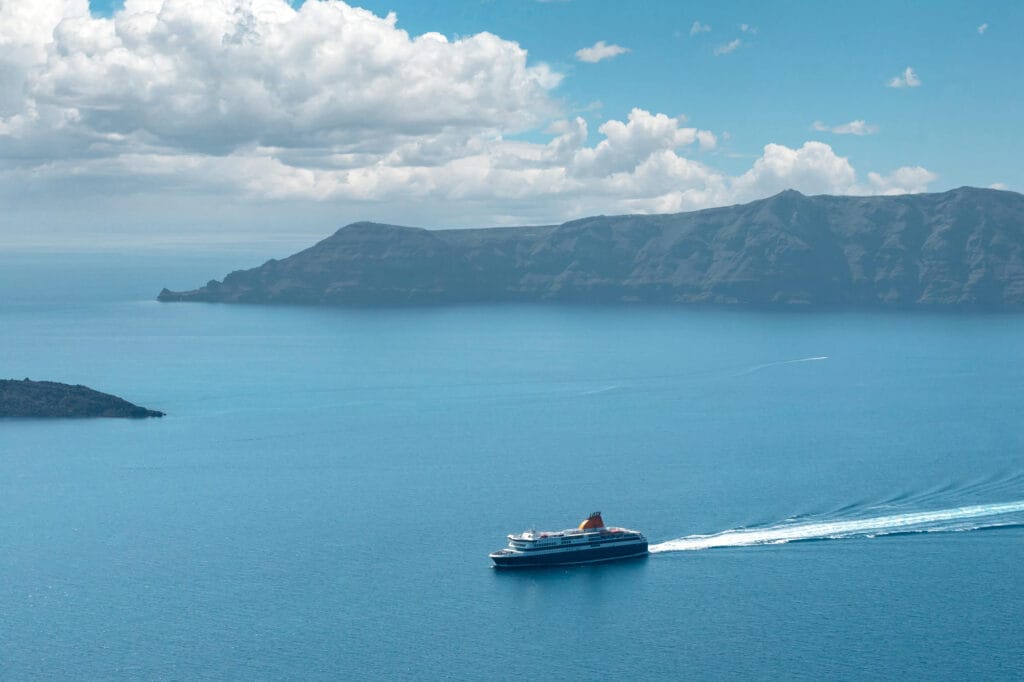
If you’re visiting the Greek islands, you’re taking a ferry. The network connects Athens’ port of Piraeus to virtually every inhabited island — some multiple times per day in summer, others just a few times a week in shoulder season.
Understanding how the system works saves time, money, and the specific frustration of missing a boat.
The Two Types of Ferry
Conventional ferries are the large, multi-deck ships that carry passengers, vehicles, and freight. They’re slower (7–12 hours for longer routes) but more stable in rough seas, more affordable, and often run overnight — which turns travel time into sleeping time. Perfect for Crete, Rhodes, and the Dodecanese.
High-speed ferries (catamarans) cut journey times roughly in half. Athens to Santorini in 5 hours instead of 8; Santorini to Mykonos in 2 hours instead of 4. They cost more, carry fewer passengers, and are more affected by wind and rough seas — the Meltemi can cause cancellations in July and August. For shorter Cyclades routes, they’re the standard choice.
Main Ferry Ports
- Piraeus (Athens): The main hub for Cyclades, Crete, Dodecanese, and Saronic Gulf routes
- Rafina (east of Athens): Serves Mykonos, Syros, Andros — often faster and cheaper than Piraeus for these routes
- Lavrio (south of Athens): Serves some Cyclades routes and Kea
- Patras: Main port for Italy and Ionian Islands
- Igoumenitsa: Serves Corfu and Italy routes from northern Greece
Getting from Athens city centre to Piraeus: Metro Line 1 (green line) runs directly to the port in about 40 minutes — the simplest option.
Getting from Athens airport to Rafina: Direct bus service runs in about 45 minutes, significantly easier than going via Athens city centre.
Popular Ferry Routes & Journey Times
| Route | Duration | Approx. Fare | Notes |
| Piraeus → Santorini | 5–8 hrs (fast: ~5) | €45–70 (fast) | Book ahead in summer |
| Piraeus → Mykonos | 4–5 hrs (fast: ~2.5) | €40–65 (fast) | Book ahead in summer |
| Piraeus → Crete (Heraklion) | 7–9 hrs (overnight) | €35–55 | Book ahead in summer |
| Piraeus → Rhodes | 12–18 hrs (overnight) | €45–75 | Book ahead in summer |
| Santorini → Mykonos | 2–3 hrs (fast) | €40–55 | Book ahead in summer |
| Mykonos → Naxos/Paros | 45 min – 1.5 hrs | €20–35 | Book ahead in summer |
| Rafina → Mykonos | 4.5 hrs (fast: ~2.5) | €35–60 | Book ahead in summer |
| Igoumenitsa → Corfu | 1.5 hrs | €10–15 | Book ahead in summer |
All times and prices are approximate and vary by operator, vessel type, and season. Always check current schedules when planning.
Booking Ferry Tickets
Book online in advance — especially for July and August travel, or if you’re taking a vehicle. Walk-up tickets are available on less popular routes in shoulder season, but popular summer routes sell out.
- Ferryhopper aggregates most Greek ferry routes and operators in one place — easiest for comparison
- Direct booking through operator websites (Blue Star Ferries, Hellenic Seaways, Seajets, Minoan Lines) sometimes offers better prices
- Seat vs. cabin: for overnight ferries, a cabin is worth it — deck seats on an 8-hour overnight crossing are not comfortable
- Booking car space: always reserve vehicle space separately and in advance — it fills faster than passenger seats
- Travel agents in Piraeus port and on the islands can book same-day tickets for less popular routes
Ferry Delays & Cancellations
Ferries in Greece do get delayed and, in strong Meltemi conditions, cancelled. The standard advice:
- Never book a flight home the day after a critical ferry crossing in peak summer
- Always have a buffer day before any flight departure when island hopping in July–August
- Ferry companies typically rebook passengers on the next available sailing at no extra cost
- Check wind forecasts (Windguru is popular with Greek island travellers) if you’re planning a crossing during Meltemi season
Island Hopping by Ferry: The Logistics
Multi-island trips require a little more planning than a simple return trip. A few things that catch travellers off-guard:
- Not all islands connect directly — you may need to return to Piraeus between certain routes
- The Cyclades (Santorini, Mykonos, Paros, Naxos) connect well to each other
- Moving from the Cyclades to the Dodecanese (Rhodes, Kos) requires going back through Piraeus or flying
- Crete has multiple ports (Heraklion, Chania, Rethymno, Agios Nikolaos) — your destination on the island determines which port to use
Full island hopping routes in our Island Hopping in Greece guide
Domestic Flights: When Flying Makes Sense
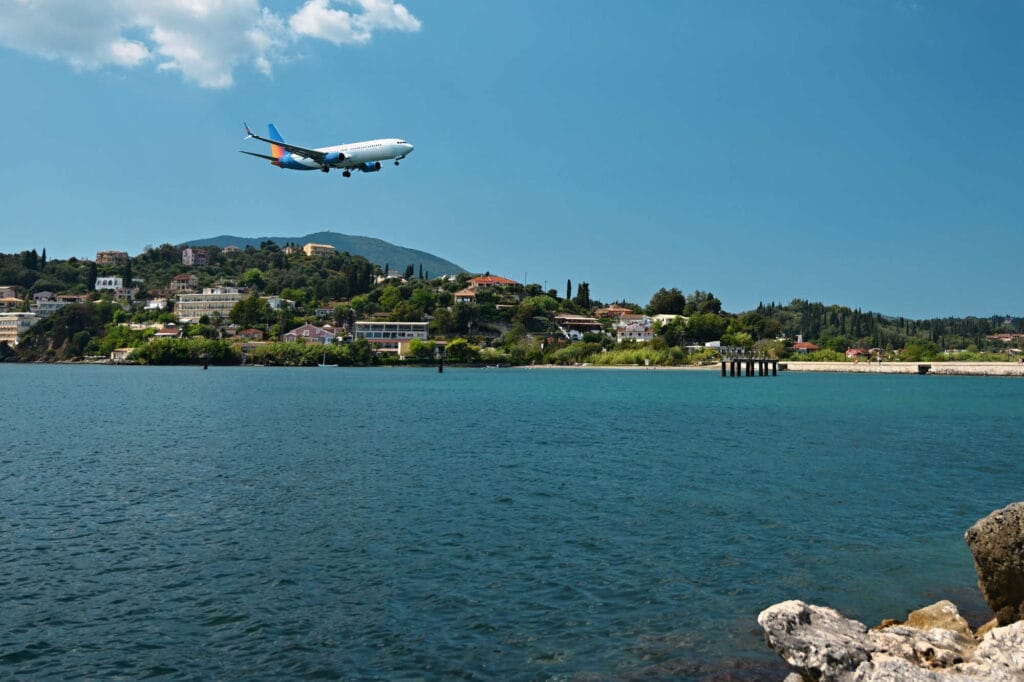
Greece has a well-developed network of domestic flights, operated mainly by Olympic Air (part of Aegean Airlines) and Sky Express. For routes where the ferry takes 8+ hours, a 45-minute flight often makes more sense — especially if you’re short on time or travelling with children.
When to Fly Instead of Ferry
- Athens to Crete: a 45-minute flight vs. 7–9 hours on the ferry — flying wins for most travellers
- Athens to Rhodes: a 50-minute flight vs. 12–18 hours by sea
- Connecting between island groups: Cyclades to Dodecanese, or Aegean islands to Ionian islands
- When travelling with young children: short flights beat long ferry crossings
- When ferry schedules don’t align with your itinerary
The tradeoff: you miss the experience of arriving at an island by sea, which is genuinely beautiful on many routes — especially sailing into Santorini’s caldera or approaching Corfu through the Ionian.
Island Airports with International Connections
| Airport (Code) | From ATH | Fare Range | Notes |
| Santorini (JTR) | ~30 min | €40–90 from ATH | Direct international flights from many EU cities |
| Mykonos (JMK) | ~30 min | €40–90 from ATH | Strong international connections in summer |
| Heraklion, Crete (HER) | ~45 min | €40–80 from ATH | One of the busiest airports in Greece |
| Rhodes (RHO) | ~50 min | €45–90 from ATH | Direct charters from UK, Germany, Scandinavia |
| Corfu (CFU) | ~55 min | €45–85 from ATH | Very popular with British and German travellers |
| Zakynthos (ZTH) | ~55 min | €40–80 from ATH | Charter-heavy; strong UK connections |
Flying directly into an island airport bypasses Athens entirely — ideal for shorter trips focused on one or two islands.
Booking Domestic Flights
- Book through Aegean Airlines or Sky Express websites for best availability and prices
- Google Flights and Skyscanner aggregate domestic routes alongside international
- Prices are reasonable when booked 4–8 weeks ahead; last-minute fares rise sharply in summer
- Luggage allowances on domestic flights are typically 15–23kg checked, 8kg cabin — confirm when booking
Renting a Car in Greece
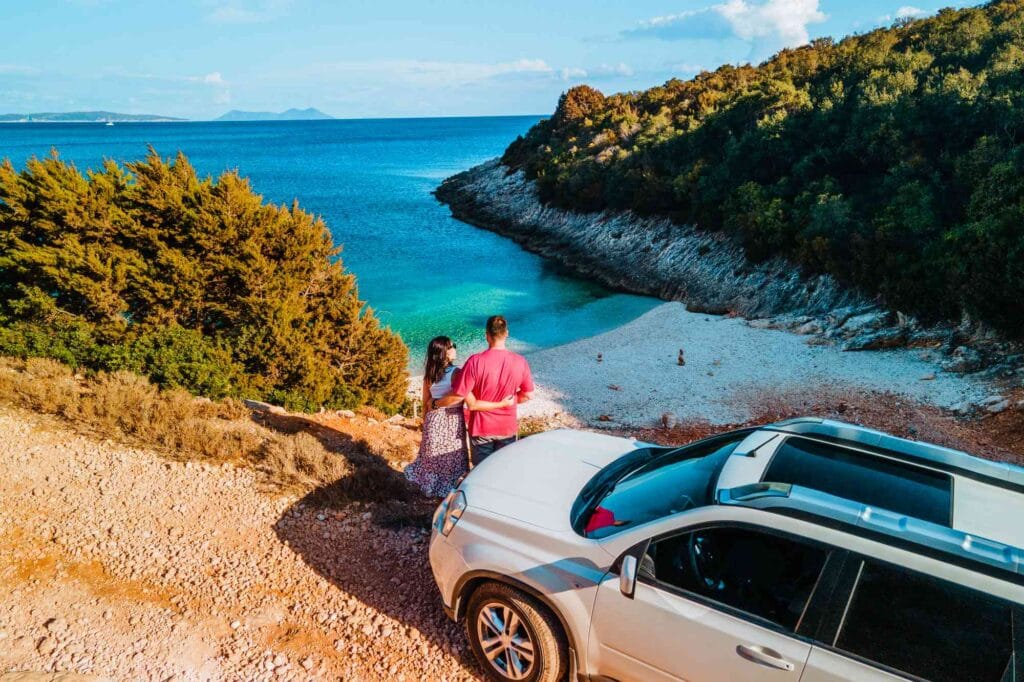
A rental car is one of the best investments you can make for a Greece trip — particularly on larger islands and the mainland. It’s the difference between seeing the 10 tourist spots on a bus tour and discovering a deserted cove, a hilltop monastery, and a family-run taverna that isn’t in any guidebook.
Where a Rental Car Is Worth It
- Crete: Large enough that the best beaches, gorges, and villages are genuinely inaccessible without wheels
- Rhodes: Similarly spread out — the island’s interior and west coast are car territory
- Corfu: Northern Corfu and the interior are best explored by car
- Peloponnese: Essential — the ancient sites at Mycenae, Epidaurus, and Mystras are spread across the peninsula
- Mainland Greece: Meteora, Delphi, Thermopylae — all require a car or a dedicated tour
Where a Car Adds Less Value
- Santorini: The island is small, roads are narrow and steep, parking is limited — the local bus (KTEL) covers the main routes well
- Mykonos: Notoriously difficult to navigate and park; walking and local buses are better for most visitors
- Athens: Metro and walking cover everything; driving in Athens is stressful and parking is scarce
How to Rent a Car in Greece: Practical Advice
- Book online at least 2–4 weeks ahead — prices increase significantly closer to the date, especially in summer
- Compare via Rentalcars.com, Discover Cars, or directly with local companies for best rates
- Local rental companies are often cheaper than international chains — check reviews carefully
- Automatic vs. manual: automatic costs 20–40% more; Greek roads, particularly on islands, are manageable in manual if you’re comfortable
- Full-to-full fuel policy is cleaner than other options — fill up before returning
- Credit card required for the deposit — check your card’s car rental insurance coverage before paying for extra insurance
- International Driving Permit (IDP): technically required alongside your licence if your licence is not in the Latin alphabet — in practice, rarely requested, but good to have
Driving in Greece: What to Expect
Greek drivers are confident and road conditions vary widely. City driving is hectic; mountain roads can be narrow with no guardrails and occasional goats. Island roads are generally well-maintained on main routes, but secondary roads can deteriorate quickly.
- Drive on the right; overtake on the left
- Speed limits: 50km/h in urban areas, 90km/h on rural roads, 130km/h on motorways
- Drink driving laws are strict — blood alcohol limit is 0.05% (lower than the UK and US)
- Download Google Maps or Maps.me offline before heading into rural areas — mobile signal drops in mountains
- Petrol stations close early in rural areas — fill up in the main town before exploring
- Parking: look for blue lines (paid parking), white lines (free), yellow lines (no parking)
Scooters, ATVs & Motorbikes on the Islands
On smaller islands like Santorini, Paros, and Milos, renting a scooter or ATV is extremely common. It’s fun, practical, and cheap (€15–30/day for an ATV). A few important caveats:
- Helmet laws apply — wear one, and check that the rental includes one
- Cobblestone streets in old towns are slippery, especially after rain or in sandals
- ATVs are involved in a disproportionate share of tourist injuries in Greece — drive sensibly
- A Category A driving licence is required for motorbikes over 50cc
Getting Around Athens
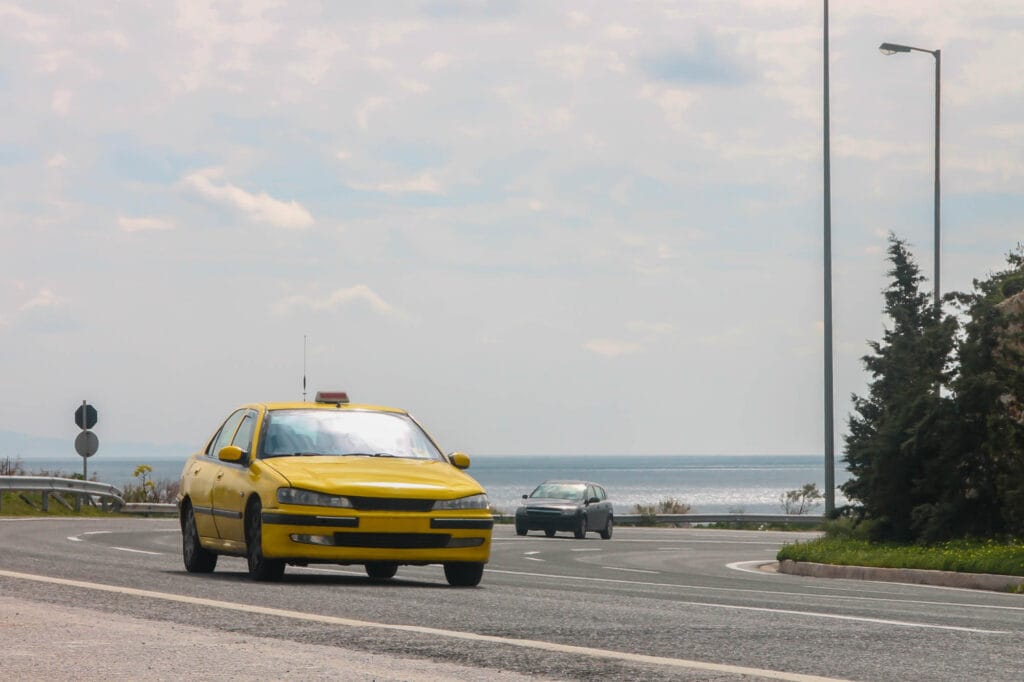
Athens has good public transport — the Metro in particular is clean, efficient, air-conditioned, and inexpensive. For most visitors, the combination of Metro, walking, and the occasional taxi covers everything.
The Athens Metro
- Three lines (red, blue, green) covering all major tourist areas and both ports (Piraeus and the airport)
- Runs from approximately 05:30 to midnight on weekdays; 24 hours on Friday and Saturday nights
- Single journey ticket: €1.20 (valid 90 minutes with transfers); 24-hour ticket: €4.10; airport ticket: €9
- Validate your ticket at the gate before boarding — inspectors do check
- The stations themselves are worth visiting: Syntagma and Akropoli stations display ancient artefacts found during construction
Taxis & Ride-Hailing in Athens
- Official Athens taxis are yellow — meter rate applies for city trips
- Beat (the dominant local ride-hailing app) and Uber both operate in Athens — often easier than hailing a street taxi
- Airport to city centre: fixed rate of approximately €38 daytime, €54 overnight — confirm before getting in
- Avoid drivers who offer ‘flat rates’ significantly above the standard without clear justification
Athens on Foot
Central Athens is very walkable. The Monastiraki–Plaka–Acropolis–Kolonaki corridor covers most of the main sights on foot in a half day. The main challenge is summer heat — always carry water, wear a hat, and plan big walks for early morning or late afternoon.
Intercity Buses (KTEL)

KTEL buses connect Athens to cities and towns across mainland Greece — Thessaloniki, Delphi, Nafplio, Patras, Meteora, and more. They’re comfortable, air-conditioned, affordable, and generally run on time. For mainland travellers who don’t want to drive, KTEL is the practical alternative.
- Athens’ main KTEL terminal: Kifissos (for most routes) and Liosion (for central Greece and Meteora)
- Athens to Thessaloniki: approximately 5–6 hours, €35–45
- Athens to Nafplio (Peloponnese): approximately 2.5 hours, €13–15
- Athens to Delphi: approximately 3 hours, €16–18
- Book online via ktelbus.com or at the terminal — advance booking recommended in summer
Note: For Meteora, the bus drops you in Kalambaka (the town at the base) — you’ll need a taxi, rental car, or guided tour to reach the monasteries themselves.
Transport Combinations for Popular Itineraries
Athens + Santorini + Mykonos (7–8 Days)
- Fly into Athens (ATH). 2–3 nights Athens.
- Fly Athens → Santorini (30 min) or take fast ferry from Piraeus (5 hrs).
- 2–3 nights Santorini.
- Fast ferry Santorini → Mykonos (2–3 hrs).
- 2 nights Mykonos.
- Fly Mykonos → Athens or ferry back to Piraeus for onward travel.
Full itinerary: Athens to Santorini: How to Plan the Perfect Trip
Athens + Crete (7–10 Days)
- Fly into Athens. 2 nights Athens.
- Fly Athens → Heraklion (45 min) or overnight ferry from Piraeus (8 hrs).
- Rent a car on arrival. 4–6 nights exploring Crete by car.
- Return ferry or fly back to Athens.
Full itinerary: 7 Days in Crete: A Complete Island Itinerary
Cyclades Island Hop (10 Days)
- Fast ferry Piraeus → Paros (4 hrs) or → Naxos.
- 2 nights Paros. Day trip to Naxos by local ferry.
- Fast ferry → Santorini (2 hrs from Naxos).
- 3 nights Santorini.
- Fast ferry → Mykonos (2.5 hrs).
- 2 nights Mykonos.
- Ferry back to Piraeus (4.5 hrs from Mykonos) or fly home from Mykonos.
Full itinerary: Cyclades Island Hopping: Santorini to Paros
Practical Tips for Getting Around Greece
Booking Strategy
- Ferries in summer: book 2–3 weeks ahead minimum for popular Cyclades routes; 4+ weeks for July–August
- Domestic flights: book 4–8 weeks ahead for best prices
- Car rentals: 3–4 weeks ahead in peak season; prices double or triple if you book on arrival
- Always screenshot or download booking confirmations — mobile data can be unreliable on ferries
Luggage Considerations
- Ferry travel is luggage-friendly — no size or weight limits on standard ferries
- Domestic flights have stricter limits (typically 23kg checked, 8kg cabin) — pack light for island-hopping itineraries
- Hard-sided luggage is difficult on cobblestone streets — a backpack or soft bag handles Greek terrain better
- Leave excess luggage in Athens if doing a short island trip — many hotels offer luggage storage
The Golden Rule of Greek Transport
Never book a flight home the same day as your final ferry crossing. The Meltemi, a late-running ferry, a delayed connection — any of these can turn a tight schedule into a missed flight. Always build a buffer night in Athens (or wherever your departure airport is) before flying home.
Offline Maps Are Essential
- Download your route on Google Maps or Maps.me before leaving WiFi range
- GPS signal is good across Greece; mobile data is the variable
- On remote parts of larger islands, roads may not be accurately mapped — ask locals
Explore More Travel Tips
- Greece Ferry Guide: How to Book & Navigate Islands
- Best Car Rentals in Greece: How to Choose & Book
- Greece Flights Guide: How to Get There for Less
- Island Hopping in Greece: The Ultimate Guide
- Greece Travel Tips for First-Time Visitors
- When Is the Best Time to Visit Greece?
Ready to Book Your Transport?
Use these resources to lock in your travel arrangements:
FAQ: Getting Around Greece
What is the best way to travel between Greek islands?
Ferries are the primary way to travel between islands. For shorter routes within island groups (like the Cyclades), high-speed catamarans are the most practical option. For longer routes — Athens to Crete or Athens to Rhodes — a domestic flight saves significant time and is often comparably priced once you factor in overnight ferry cabin costs.
Do I need to book ferries in advance in Greece?
In summer (July–August), yes — book at least 2–3 weeks ahead for popular Cyclades routes, and earlier if you’re taking a vehicle. Shoulder season routes (May, June, September, October) generally have walk-up availability on most routes, but booking ahead online still gets you better seat choices and sometimes lower prices.
Is it worth renting a car in Greece?
On larger islands (Crete, Rhodes, Corfu) and on the mainland (Peloponnese, northern Greece), a rental car transforms your trip by giving access to places no tour bus reaches. On smaller or compact islands like Santorini and Mykonos, the local bus network is adequate for most needs and driving adds complexity without proportional benefit.
How do I get from Athens airport to the city centre?
The Metro Line 3 (blue line) runs directly from the airport to central Athens in about 40 minutes — the cleanest, most reliable option. Express buses run 24/7 and take 60–90 minutes depending on traffic. Taxis operate a fixed rate to/from the city; confirm the rate before getting in.
What is the Piraeus port and how do I get there?
Piraeus is the main port of Athens and the hub for most Aegean ferry routes. From Athens city centre, take Metro Line 1 (green line) to the Piraeus terminal — about 40 minutes from Monastiraki. The port is large; check your ferry company’s gate number in advance, as different operators use different sections of the port.
Are there buses between Greek islands?
No — islands are only connected by ferry or plane. Within islands, local KTEL buses serve the main routes between towns and popular beaches on larger islands. On smaller islands, transport options are more limited — scooters, ATVs, and taxis fill the gap.
Can I drive my own car to Greece?
Yes, if travelling from mainland Europe. Greece is accessible by road through Bulgaria or North Macedonia, and by car ferry from Italy (Ancona, Bari, Venice, and Brindisi all serve Greek ports). If bringing a car by ferry to the islands, always book vehicle space well in advance in summer.
Is the Athens Metro easy to use?
Very. Three lines, clear signage in both Greek and English, and maps posted throughout stations. Buy your ticket at the automated machines (interface is available in English), validate at the gate, and you’re on. The 24-hour travel card at €4.10 is good value for a day of city exploration.
What is the Meltemi wind and how does it affect ferries?
The Meltemi is a strong, dry northerly wind that blows across the Aegean from July through August. It’s beneficial for temperatures but can cause ferry delays and cancellations — particularly for high-speed catamarans, which are more sensitive to wave height than conventional ferries. If you’re island hopping in peak summer, build a buffer day before any flight home.